Content Reviewed By: Dr. Steve Knighton, B.Sc., D.C. on September 11, 2026
Chiropractic License Number: 5580

TMJ Treatment Oakville

What is causing your jaw pain and TMJ?

Dr. Steve Knighton has been treating patients with jaw pain and TMJ problems since 2008. One of the things he likes about treating jaws is that no two TMJ patients seem to walk into the clinic with exactly the same problem.

TMJ and jaw pain are among the more specialized problems treated by our Oakville chiropractic team, particularly when the jaw, neck and surrounding muscles are all contributing to the symptoms.

One patient may say, “My jaw clicks every time I eat.” Another wakes up with their teeth clenched and both sides of their jaw aching. Someone else cannot open their mouth far enough to take a normal bite of food. We also see patients who have already tried a nightguard but still have jaw pain, tight muscles or headaches.

Dr. Steve assesses the jaw joint itself, how the jaw opens and tracks, the muscles that control jaw movement — including the masseter, temporalis and pterygoid muscles — and whether clenching, grinding, posture or the upper neck appear to be part of the problem.

Treatment is based on what he actually finds. Depending on the patient, Dr. Steve may use shockwave therapy, IFC, hands-on jaw muscle treatment, joint mobilization, appropriate chiropractic treatment to the neck when it is relevant, and simple exercises to work on between appointments.

Patients regularly come to our Oakville clinic from Milton, Burlington, Mississauga and farther away specifically for TMJ and jaw pain treatment. If you have been stuck Googling “TMJ treatment near me” or “jaw pain treatment near me,” watch the videos on this page. They show you much more clearly what Dr. Steve actually does than another paragraph of medical jargon ever will.

If your jaw pain is related to a workplace injury, learn how to start a WSIB claim and access approved treatment in Oakville. Jaw injuries and TMJ problems can sometimes develop after motor vehicle accidents due to impact or whiplash forces. Our car accident rehab Oakville program also treats TMJ symptoms that develop following collisions.

Book an Appointment

TMJ Anatomy and Jaw Pain Explained (Video)

TMJ & Jaw Pain Treatment Burlington and Milton

Dr. Steve Knighton takes a thorough and evidence-based approach to diagnosing and treating TMJ disorders and jaw pain. With nearly two decades of experience, he has helped countless patients find relief from discomfort and regain proper jaw function. Working on the TMJ structure he improves masseter muscle, temporalis muscle (main cause of headaches from TMJ), medial pterygoid muscle and lateral pterygoid. He also will work on the upper neck muscle groups to improve jaw mechanics.

As one of the few practitioners in Ontario utilizing shockwave therapy for TMJ conditions, Dr. Steve combines cutting-edge techniques with a holistic treatment plan. His approach includes assessing potential underlying issues in the neck and cervical spine that may contribute to jaw pain.

Additionally, he provides patients with simple yet effective at-home exercises to support their recovery and maintain long-term results.

Our Oakville clinic treats many TMJ and jaw pain patients from Milton, Burlington, and Mississauga who are searching for effective TMJ treatment near them.

Book an Appointment

TMJ Treatment and Jaw Pain Relief (Video)

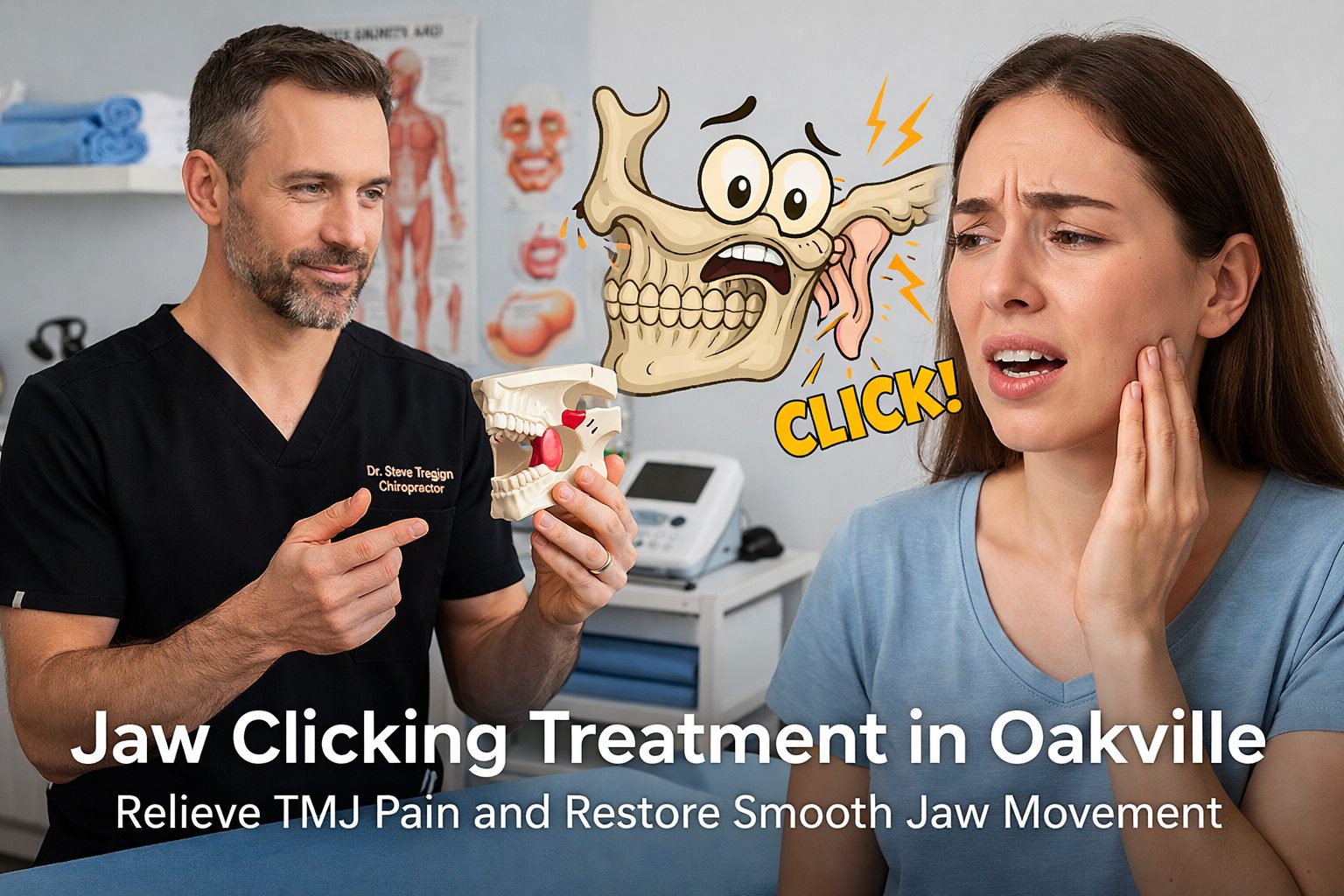
Jaw Clicking Treatment Oakville

Jaw clicking is one of the most common reasons patients ask Dr. Steve about their TMJ.

Some people have had a painless click or pop for years and it does not bother them at all. Painless joint noises are common and, by themselves, do not necessarily require treatment. What gets Dr. Steve’s attention is when the clicking becomes painful, the jaw starts catching or locking, mouth opening becomes limited, chewing hurts, or the symptoms have suddenly changed.

A common reason for clicking is movement of the small disc inside the TMJ as the jaw opens and closes. The disc can move out of its usual position and then move back into place during opening, producing a click or pop. Jaw muscle tension, clenching, grinding and joint irritation can exist alongside this.

At our Oakville clinic, Dr. Steve watches how the jaw actually opens. Does it deviate to one side? Is the click painful? Does the jaw catch? Is opening limited? Are the masseter or temporalis muscles extremely tender? Does the neck appear to be contributing?

Depending on those findings, treatment may include jaw muscle therapy, trigger point work, shockwave therapy, jaw mobility exercises and appropriate treatment of the cervical spine when the examination shows that it is relevant.

The goal is not to chase every harmless click. It is to treat the patients whose clicking is part of a painful or dysfunctional jaw problem and help them get back to chewing, yawning and opening their mouth more comfortably.

a meme of dr steve talking to a female patient about jaw pain. her jaw looks injured

Common TMJ Symptoms


Graphic showing symptoms of TMJ

  • clicking jaw

  • popping jaw

  • jaw locking

  • headaches

  • ear pain

  • difficulty chewing

  • tight jaw muscles

  • jaw pain

Severe TMJ disorders can make it difficult to chew your food and sleeping may become painful. Some patients even complain of headaches and neck pain coming from their jaw.

What Our TMJ and Jaw Pain Patients Are saying

  • Dr Steve and his staff are amazing. Love his high energy and enthusiasm. Have seen several Dr’s for my shoulder injury and Dr Steve is the only one that has fully explained what’s going on that made sense. Only had a few treatments but already noticing an improvement. Front desk... read more

    Steve & Angela Pinder Avatar Steve & Angela Pinder
    October 7, 2024

    My husband and I have been attending the Nottinghill Family Wellness Centre for almost a year now, and we are so pleased. Dr. Jenn is consistently professional, caring and helpful to both of us for our physio well-being. She is a brightness to our day every time we visit. The... read more

    Elle S Avatar Elle S
    February 13, 2025

    We had an excellent experience from our very first phone call to book an appointment through to my dad’s last visit. My dad was experiencing severe episodes of vertigo, and the office was incredibly accommodating. The receiptions was awesome and booked him in on an urgent basis and, because his nausea... read more

    Hiba K Avatar Hiba K
    August 18, 2026
  • Another great experience, thanks for keeping me going!

    Guillaume Grincourt Avatar Guillaume Grincourt
    June 7, 2024

    Great clinic. Pain free after few visits.

    Mario M Avatar Mario M
    February 6, 2025

    Dr. Steve comes highly recommended. He has helped me recover from multiple injuries, and the improvement has been remarkable. My daughter is also a patient, and she’s experienced the same positive results. The entire staff is friendly, welcoming, and truly cares about their patients. We’re grateful to have found such... read more

    Yvette Avatar Yvette
    March 18, 2026
  • Dr. Steve is professional and friendly. He explained the cause of knee pain and answered all my concerns about the injury. His assistant and all staff at the clinic are really nice and patient. As a tourist, it is very frustrating to have an injury during the trip. However, they... read more

    Bo Zhang Avatar Bo Zhang
    August 7, 2024

    I would definitely recommend the Nottinghill Family Wellness Centre for anyone in need of chiropractic services. Dr. Steve significantly improved my back posture after two to three sessions; the staff are both friendly and professional, and the atmosphere is very relaxing.

    Rick Dong Avatar Rick Dong
    October 7, 2024

    I’ve been going to Steve and his team for chiropractic care for several years, and they have helped me tremendously. Despite living in downtown Toronto, I make the trip out to Oakville because the quality of care is truly worth it. Steve takes a holistic approach, looking at the... read more

    Aman Bahl Avatar Aman Bahl
    November 7, 2024

TMJ & Jaw Pain Treatment Burlington and Milton

Doctor Steve has been treating TMJ disorders and jaw pain since 2008 and sees a wide variety of jaw problems at our Oakville clinic.

Some patients have primarily muscular TMJ problems involving extremely tight masseter, temporalis or pterygoid muscles. Others have clicking, restricted jaw opening, abnormal tracking, clenching, grinding or a combination of several problems.

Doctor Steve examines how the jaw opens and closes, which muscles are painful or restricted, and whether the upper neck appears to be contributing to the problem.

Treatment is then based on what is actually found during the examination.

Depending on the patient, this may include IFC, shockwave therapy, hands-on jaw muscle treatment, trigger point therapy, jaw mobilization, cervical spine treatment when appropriate and simple exercises to work on at home.

Learn more about Neck Pain Treatment in Oakville

Our Oakville clinic regularly treats TMJ and jaw pain patients travelling from Milton, Burlington and Mississauga.

Now Offering Shockwave Treatment for TMJ Near Milton

How Dr. Steve Treats TMJ and Jaw Pain in Oakville

At our Oakville clinic, TMJ treatment focuses on reducing muscle tension, restoring proper jaw movement, and improving joint function using evidence-based therapies.

Step 1. Interferential Current Therapy (IFC) for Jaw Pain

For many TMJ patients, we start with Interferential Current Therapy, or IFC, to help settle painful and tight jaw muscles before I begin the hands-on portion of treatment.

Treating the jaw is a little different from treating a back or shoulder. We normally use suction IFC at the clinic, but suction cups obviously do not work particularly well on somebody’s face, so adhesive electrodes are placed over the appropriate jaw muscles instead.

The stimulation should feel strong but comfortable. Because the electrodes are sitting over facial muscles, patients occasionally notice small muscle twitches around the jaw or face during treatment. That can look a little strange the first time, but it is simply the muscles responding to the electrical stimulation.

Dr. Steve often uses IFC as preparation for the rest of the appointment rather than treating it as the main solution for TMJ. Once the jaw muscles are more relaxed, I can move into shockwave therapy and hands-on treatment more comfortably.

a female patient with ifc sticky pads taped to her face for jaw pain treatment

Step 2. Shockwave Therapy for TMJ Oakville

Shockwave Therapy is a highly effective, evidence-based treatment for chronic jaw pain and muscle tightness. Dr. Steve utilizes a specialized shockwave applicator designed specifically for TMJ conditions, delivering 600 to 800 targeted pulses per side. This advanced therapy helps break down scar tissue, increase blood circulation, and reduce inflammation in the masseter and temporalis muscles. Whether its a painful jaw with chewing or a constant jaw clicking issue we have the treatment you need!

Many patients notice significant relief after just a few sessions, making Shockwave Therapy an excellent option for those struggling with persistent jaw discomfort. If you’re dealing with TMJ pain, let Dr. Steve and his team provide the expert care you need to restore function and relieve tension.

TMJ Treatment Near Mississauga

Many Mississauga patients travel to our Oakville clinic for comprehensive TMJ treatment and shockwave therapy. If you are coming from Mississauga for TMJ treatment at our clinic let us know so we can find a time that works with traffic and with your schedule. We are open almost every Saturday of the year so we can get you in with limited traffic if you are coming from North Mississauga or closer to Etobicoke with limited traffic. We all know how bad the Ford split can be coming from Mississauga at all times of the day!

female getting right jaw treated with shockwave, shockwave is a hand held pneumatic gun, hits 15 times a second for 90 seconds

Step 3. Active Release Therapy (ART) & Trigger Point Therapy For Jaw Pain Relief

Following Shockwave Therapy, Dr. Steve utilizes hands-on soft tissue techniques to release trigger points in the jaw and surrounding facial muscles. Through a combination of deep tissue work and precise manual adjustments, these therapies help improve jaw mobility, alleviate muscle tightness, and reduce tension headaches.

Active Release and trigger point therapy improves jaw mechanics and works great for treatment on clicking jaws and unusual jaw opening patterns. He works with his thumbs to release the muscles of the jaw including the masseter, temporalis and pterygoid muscles.

By targeting the root cause of discomfort, Dr. Steve’s comprehensive approach ensures long-lasting relief for TMJ sufferers. If you’re experiencing persistent jaw pain or stiffness, his expert care can help restore function and get you back to feeling your best. If your traveling from Milton, Burlington or Mississauga let our staff know and we will find a time that works for you and traffic!

Dr Steve performing jaw muscle treatment for TMJ pain for a patient near Milton Ontario

Step 4. Chiropractic Neck Adjustments for TMJ Pain

Almost every TMJ patient Dr. Steve treats at our Oakville clinic has some degree of cervical spine dysfunction contributing to their jaw pain. The temporomandibular joint does not work in isolation. It functions closely with the joints and muscles of the upper neck, particularly the C1, C2, and C3 vertebrae, along with surrounding muscles such as the sternocleidomastoid, upper trapezius, and suboccipital muscles.

When these areas become tight, restricted, or irritated, they can contribute to jaw pain, facial tension, headaches, and limited jaw movement.

Many patients are surprised to learn that restricted motion in the cervical spine can directly affect how the jaw opens, closes, and moves side to side. Poor posture, prolonged computer use, stress-related muscle tension, previous injuries, and whiplash are all common causes of upper neck dysfunction that can place additional strain on the temporomandibular joint.

At Nottinghill Family Wellness Centre in Oakville, Dr. Steve carefully evaluates the relationship between the jaw and the cervical spine when assessing TMJ problems. If restricted joints in the upper neck are contributing to the patient’s symptoms, a gentle chiropractic neck adjustment may be performed to restore proper joint motion and reduce mechanical stress affecting the jaw.

Before any adjustment is performed, surrounding muscles are typically treated first using Active Release Techniques (ART), trigger point therapy, and other soft tissue treatments. Addressing the muscle tension beforehand allows the adjustment to be more comfortable and effective while helping restore normal muscle function around both the neck and jaw.

Many TMJ patients notice improvements not only in jaw pain but also in related symptoms such as headaches, neck stiffness, and facial muscle tension once the cervical spine begins moving normally again.

Our Oakville clinic regularly treats TMJ patients from Burlington, Milton, and Mississauga who are searching for effective TMJ treatment near them. By addressing both the jaw joint and the cervical spine together, treatment focuses on correcting the underlying biomechanical causes of TMJ dysfunction rather than simply managing symptoms.

Book an Appointment


chiropractor adjusting a patients neck

How Does Shockwave Therapy Help With Jaw Pain?

Female patient receiving shockwave treatment for Jaw pain

Shockwave Therapy is one of the main treatments Doctor Steve uses for TMJ patients with extremely tight, painful or sensitive jaw muscles.

Our shockwave unit uses a pneumatic applicator that delivers rapid mechanical pulses through the skin.

For TMJ treatment, Doctor Steve uses a smaller applicator designed for treating smaller areas. The masseter is one of the main muscles treated, along with the temporalis and other involved jaw muscles when appropriate.

Doctor Steve generally delivers approximately 600 to 800 targeted shockwave pulses on each side of the jaw.

Treatment only takes a few minutes.

Areas that are particularly tight or irritated can feel tender during shockwave, but the intensity can be adjusted throughout the treatment.

Shockwave fits into the rest of our TMJ protocol rather than being used by itself.

IFC helps relax and prepare the muscles first. Shockwave is then used on the painful jaw muscles, followed by Doctor Steve’s hands-on muscle and trigger point treatment.

Research into shockwave therapy for temporomandibular disorders has continued to grow, with studies reporting improvements in jaw pain and mouth opening when shockwave is incorporated into treatment.

Research: Shockwave Therapy for Temporomandibular Disorders

Is There Research on Shockwave Therapy for TMJ?

Yes.

Research on extracorporeal shockwave therapy for temporomandibular disorders has continued to grow. A 2026 systematic review and meta-analysis of 14 randomized controlled trials involving 1,107 patients found improvements in pain and mouth opening when shockwave was used as an adjunct to other treatment — which is very similar to how Doctor Steve uses it as part of the overall TMJ protocol.

Clinically, Doctor Steve continues using shockwave because it works extremely well as part of the overall TMJ protocol for many of the patients treated at our Oakville clinic.

As always, the patient has to be improving.

If treatment is working, we continue progressing it.

If it is not, Doctor Steve reassesses why.

At Home Jaw Exercises for TMJ Pain!

One of the simplest exercises Doctor Steve gives some TMJ patients is what he calls the cork stretch.

Yes, literally a wine cork.

The cork acts as a very basic spacer that allows the jaw-opening muscles and joint to relax into a gentle sustained stretch.

The patient places the cork upright between the front teeth and allows the jaw to relax around it rather than biting hard into the cork.

Start gently.

A typical starting point is approximately 20 to 30 seconds at a time for several repetitions, depending on how limited or sensitive the jaw is.

The stretch should feel gentle.

It should not produce sharp pain, locking or a significant increase in symptoms.

Some patients need the cork shortened because they cannot comfortably open far enough to use a full-size cork initially.

Others eventually progress to a larger opening.

This is one of those exercises where more is definitely not automatically better.

If the jaw locks, has recently become significantly restricted, or the exercise makes symptoms worse, stop and have the jaw assessed before continuing.

Most TMJ problems can initially be assessed clinically based on the history and physical examination. Imaging such as X-rays, CT or MRI is not automatically necessary for every patient, but it may be appropriate when there has been significant trauma, persistent locking, suspected joint pathology, progressive symptoms or when the diagnosis remains unclear.

If you already have previous jaw imaging or reports, bring them with you.

6 Signs of TMJ and what you can do to fix your jaw pain!

cork stretch for tmj


Doctor Steve’s Favourite At-Home Exercises for Jaw Pain

Can a chiropractor treat TMJ? Treatment options for TMJ in Oakville.

Chiropractors can assess and treat many musculoskeletal contributors to TMJ and jaw pain, particularly when the problem involves painful jaw muscles, restricted movement, headaches or cervical spine dysfunction.

Doctor Steve’s treatment approach is not completely cookie-cutter.

Some patients respond quickly.

Others have been clenching for years, have significant jaw restriction or have already tried multiple treatments before arriving at the clinic.

Doctor Steve looks for meaningful progress in pain, jaw opening, chewing or function as treatment continues.

If a patient is not improving as expected, the diagnosis should be reassessed rather than simply continuing the same treatment indefinitely.

Depending on what is found, a patient may be referred back to their dentist, family physician or another appropriate healthcare provider, or diagnostic imaging may be considered when clinically indicated.

Treatment at our Oakville clinic may include:

  • Interferential Current Therapy (IFC)
  • Shockwave Therapy
  • Hands-on jaw muscle treatment
  • Trigger point therapy
  • Jaw mobilization
  • Appropriate cervical spine treatment
  • At-home jaw mobility exercises

The goal is to use the treatments that make sense for that patient’s particular TMJ problem.

A doctor performing hands on therapy for TMJ

Acupuncture Treatment for TMJ and jaw pain?

A female patient receiving acupuncture treatment for TMJ pain

Doctor Jenn provides acupuncture at our Oakville clinic and treats patients with TMJ, jaw pain, jaw tension and related muscle problems.

TMJ patients frequently have extremely tight muscles surrounding the jaw, particularly the masseter and temporalis.

Clenching, grinding and prolonged jaw tension can leave these muscles painful and overactive and may also contribute to headaches, temple pain and facial tension.

Acupuncture gives us another way of treating these painful muscular areas.

Doctor Jenn uses very thin acupuncture needles at selected points around the jaw, face and neck depending on the patient’s symptoms and examination.

Some patients specifically come to the clinic because they want acupuncture for their TMJ symptoms.

For others, acupuncture can be combined with hands-on jaw treatment, mobility work and other parts of their care.

Not every TMJ patient needs acupuncture.

It is another treatment option available at the clinic for patients when it makes sense or when acupuncture is the treatment approach they prefer.

Learn more about Acupuncture in Oakville

TMJ Treatment and Jaw Pain FAQs


What is TMJ?

TMJ stands for temporomandibular joint, the joint directly in front of each ear that allows the jaw to open, close and move side to side. TMD is the broader term for painful or dysfunctional problems involving the joint, disc and jaw muscles.

What does TMJ pain feel like?

TMJ pain may feel like an ache directly in front of the ear, tightness through the jaw muscles, pain with chewing, painful clicking, headaches, facial pain or difficulty opening the mouth normally.

Why does my jaw click when I open my mouth?

Jaw clicking commonly occurs when the small articular disc inside the TMJ moves as the jaw opens and closes. Painless clicking is common; Doctor Steve becomes more concerned when clicking is painful, accompanied by locking or associated with restricted jaw movement.

Can clenching cause TMJ pain?

Yes. Repeated clenching can overload the masseter, temporalis and other jaw muscles and contribute to morning jaw pain, headaches, facial tension and painful chewing.

Can TMJ cause headaches?

Yes. TMJ problems and significant jaw muscle tension can occur alongside headaches, particularly when the temporalis, masseter and upper cervical muscles are involved.

Can TMJ cause ear pain?

Yes. The TMJ sits immediately in front of the ear, so jaw problems can produce pain, pressure or aching around the ear even when the ear itself is normal.

Does Shockwave Therapy help TMJ?

Shockwave Therapy is one of the main treatments Doctor Steve uses when painful and extremely tight jaw muscles are a major part of the TMJ problem. It is normally combined with IFC, hands-on jaw muscle treatment and mobility work rather than used by itself.

Can acupuncture help TMJ?

Acupuncture can be useful for some patients with TMJ pain, jaw tension and painful chewing muscles. Doctor Jenn provides acupuncture for TMJ patients at our Oakville clinic and may combine it with other treatment when appropriate.

Can a chiropractor treat TMJ?

Yes. Doctor Steve regularly assesses and treats mechanical TMJ problems involving painful jaw muscles, restricted jaw movement, trigger points and associated cervical spine dysfunction.

Where can I get TMJ treatment in Oakville?

Our Oakville clinic treats TMJ and jaw pain using a combination of IFC, Shockwave Therapy, hands-on jaw muscle treatment, trigger point therapy, jaw mobilization, appropriate cervical treatment and at-home exercises.

TMJ Treatment and Jaw Pain FAQs

What Does TMJ Mean?

TMJ stands for temporomandibular joint, the joint connecting the lower jaw to the skull just in front of each ear.

Technically, TMD — temporomandibular disorder — describes problems involving the TMJ, jaw muscles, articular disc and surrounding structures.

Most patients simply call the entire problem “TMJ,” so both terms are used throughout this page.

How Do I Know if I Have TMJ?

Common TMJ symptoms include:

  • pain in front of the ear
  • painful chewing
  • jaw clicking or popping
  • locking or catching
  • limited mouth opening
  • painful or tight jaw muscles
  • pain from clenching or grinding
  • headaches
  • facial or temple pain

Doctor Steve examines the jaw to determine which structures are actually producing the symptoms.

Is Jaw Clicking Always a Problem?

No.

A painless click that has been present for years may not need treatment.

Clicking becomes more important when it is painful or accompanied by locking, catching, restricted mouth opening or difficulty chewing.

Why Does My Jaw Click and Hurt When I Chew?

Painful clicking may involve the TMJ disc, joint irritation, abnormal jaw movement or painful surrounding muscles.

Doctor Steve watches how the jaw opens and closes and checks whether the click occurs together with restricted movement, muscle tenderness or locking.

What Causes TMJ Pain?

Common contributors include:

  • clenching
  • teeth grinding
  • tight jaw muscles
  • trauma
  • repetitive jaw loading
  • joint irritation
  • disc displacement
  • arthritis
  • restricted jaw movement
  • previous whiplash
  • neck dysfunction

Many patients have more than one contributing factor.

Why Does My Jaw Hurt More in the Morning?

Morning jaw pain commonly occurs in people who clench or grind during sleep.

Patients may wake with sore masseter muscles, facial tension, headaches or stiffness when they first try to open their mouth.

Can Stress Make TMJ Worse?

Yes.

Stress often increases unconscious clenching and jaw muscle tension. Someone may hold their teeth together or tense their jaw for hours without realizing it.

Can TMJ Cause Headaches?

Yes.

The temporalis is both a major chewing muscle and a large muscle covering the temple. Jaw tension can also occur together with tight masseter and upper cervical muscles.

Doctor Steve regularly sees patients whose headaches occur alongside significant jaw tension.

Learn more about Headache Treatment in Oakville

Can TMJ Cause Ear Pain or Pressure?

Yes.

Because the TMJ sits directly in front of the ear, TMJ problems can produce aching, pressure or discomfort around the ear.

Persistent ear symptoms, hearing changes, drainage or fever should still be medically assessed.

Can TMJ Cause Neck Pain?

Yes. Jaw and neck symptoms frequently occur together.

Doctor Steve examines the upper cervical spine when the patient’s history and examination suggest the neck is contributing to the overall problem.

Learn more about Neck Pain Treatment in Oakville

What Does It Mean When My Jaw Locks?

Jaw locking means the joint temporarily or persistently cannot move through its normal range.

Some patients experience brief catching. Others suddenly cannot open their mouth normally.

Persistent locking or significant loss of mouth opening should be properly assessed.

What Is the Best Treatment for TMJ?

The best treatment depends on what Doctor Steve finds during the examination.

For many mechanical TMJ problems, our treatment protocol may include:

  • IFC
  • Shockwave Therapy
  • Active Release and hands-on jaw muscle treatment
  • trigger point therapy
  • jaw mobilization
  • cervical spine treatment when appropriate
  • at-home exercises

The different parts of the protocol work together rather than relying on one treatment to do everything.

How Does Shockwave Therapy Help TMJ?

Shockwave Therapy delivers rapid mechanical pulses into painful and tight jaw muscles.

Doctor Steve most commonly uses it over the masseter and other involved jaw muscles after IFC has helped prepare the area for treatment.

Shockwave is then followed by hands-on muscle and trigger point treatment as part of the overall TMJ protocol.

Learn more about Shockwave Therapy in Oakville

Is Shockwave Therapy Good for Tight Masseter Muscles?

This is one of the main reasons Doctor Steve uses Shockwave Therapy for TMJ.

The masseter can become extremely tight and tender in patients who clench or grind their teeth. Shockwave allows Doctor Steve to directly treat these painful muscular areas before moving into hands-on treatment.

Can Shockwave Therapy Help Jaw Clicking?

It depends on why the jaw is clicking.

Shockwave does not physically reposition the TMJ disc. However, when painful clicking occurs together with significant masseter or other jaw muscle tension, treating those muscles can be an important part of restoring more comfortable jaw movement.

Doctor Steve treats the whole mechanical problem, not simply the noise.

How Many Shockwave Pulses Does Doctor Steve Use for TMJ?

Doctor Steve generally uses approximately 600 to 800 shockwave pulses on each side of the jaw, depending on the patient’s examination and which muscles are involved.

A smaller applicator is used because the jaw muscles are much smaller than the muscles normally treated elsewhere in the body.

What Does Shockwave Therapy on the Jaw Feel Like?

Patients normally feel a rapid tapping or pulsing sensation.

Very tight areas of the masseter can be tender during treatment, but the intensity can be adjusted. TMJ shockwave treatment itself normally only takes a few minutes.

Is There Research on Shockwave Therapy for TMJ?

Yes.

Research on extracorporeal shockwave therapy for temporomandibular disorders has continued to grow. A 2026 systematic review and meta-analysis found improvements in pain and mouth opening when shockwave was used as an adjunct to other treatment, which is similar to how Doctor Steve uses it in the clinic. (PubMed Central (PMC))

2026 Systematic Review and Meta-Analysis — Shockwave Therapy for Temporomandibular Disorders

Does Acupuncture Help TMJ and Jaw Pain?

Acupuncture can be useful for patients with TMJ-related pain, jaw tension and painful chewing muscles.

Doctor Jenn uses acupuncture for selected TMJ patients, particularly when tight or painful jaw muscles are a major part of the problem.

Acupuncture has also been specifically studied for temporomandibular disorders. A systematic review and meta-analysis of randomized clinical trials found improvements in pain and other TMD outcomes when acupuncture was compared with active controls or added to other treatment.

Systematic Review and Meta-Analysis — Acupuncture for Temporomandibular Disorders

Learn more about Acupuncture in Oakville

Where Are Acupuncture Needles Placed for TMJ?

The exact points depend on the patient.

Doctor Jenn may use acupuncture points around the jaw, face, temple or neck depending on where the patient is experiencing pain and muscle tension.

Is Acupuncture or Shockwave Better for TMJ?

They are different treatments and do not need to compete with each other.

Doctor Steve commonly uses Shockwave Therapy when extremely tight and painful jaw muscles are a major component of the problem.

Doctor Jenn may use acupuncture for patients who respond well to acupuncture or prefer that treatment approach.

Some patients may use both as part of their overall care.

Can I Get Acupuncture and Chiropractic Treatment for TMJ at the Same Clinic?

Yes.

Our Oakville clinic provides chiropractic TMJ treatment with Doctor Steve and acupuncture with Doctor Jenn.

This allows patients to use different conservative treatment options within the same clinic when appropriate.

Do Mouthguards Help TMJ?

They can, especially when significant clenching or grinding is occurring.

A nightguard can help protect the teeth, but it does not necessarily treat every painful muscle, trigger point, restricted joint or abnormal movement pattern.

That is why Doctor Steve sees plenty of patients who already wear a nightguard but still have TMJ pain.

Why Does My TMJ Still Hurt Even Though I Wear a Nightguard?

A nightguard addresses only part of the problem.

If the masseter and temporalis remain extremely tight, jaw movement is restricted or the joint itself is irritated, symptoms can continue despite wearing a dental appliance.

Should I See a Dentist or Chiropractor for TMJ?

It depends on what is causing the problem.

Dentists are important for dental disease, damaged teeth, significant grinding-related tooth wear and dental appliances.

Doctor Steve focuses on the musculoskeletal side of TMJ — jaw movement, painful muscles, trigger points, joint mechanics and the cervical spine when it is involved.

Some patients benefit from both.

What Exercises Help TMJ?

Doctor Steve commonly uses gentle jaw mobility exercises and the cork stretch described earlier on this page.

The correct exercise depends on whether the problem is primarily muscular, restricted movement, painful clicking or another mechanical issue.

Should I Stop Chewing Gum if I Have TMJ?

Usually while the jaw is irritated.

Repeated gum chewing loads the same muscles and joints that may already be painful.

Temporarily reducing gum, extremely chewy foods and unnecessarily wide mouth opening often makes sense while an aggravated jaw settles.

Do I Need an X-Ray or MRI for TMJ?

Not necessarily.

Many TMJ problems can initially be assessed from the patient’s history and physical examination.

Imaging may be appropriate following significant trauma, persistent locking, progressive restriction, suspected arthritis or structural joint disease, or when the examination does not adequately explain the symptoms.

MRI can be particularly useful when detailed assessment of the TMJ disc and other soft tissues is required.

How Long Does TMJ Treatment Take?

There is no single treatment number.

Doctor Steve expects to see measurable changes as treatment progresses, such as:

  • less pain
  • easier chewing
  • better mouth opening
  • reduced muscle tenderness
  • improved jaw tracking
  • less locking or catching

If the patient is not improving the way Doctor Steve expects, the problem is reassessed.

Do You Treat TMJ Patients From Milton, Burlington and Mississauga?

Yes.

Doctor Steve regularly treats TMJ and jaw pain patients who travel to our Oakville clinic from Milton, Burlington, Mississauga and surrounding communities.

If you are coming from outside Oakville, let the front desk know and we will do our best to find an appointment time that works around traffic.

When Should Jaw Pain Be Medically or Dentally Evaluated?

Jaw pain should receive appropriate medical or dental assessment when associated with:

  • significant trauma
  • suspected fracture
  • persistent or severe locking
  • progressive inability to open the mouth
  • significant swelling
  • fever or infection
  • major dental pain
  • facial numbness or neurological symptoms
  • unexplained weight loss
  • symptoms that do not appear musculoskeletal

Doctor Steve also refers patients when the examination does not fit the type of mechanical TMJ problem treated at our Oakville clinic.