Content Reviewed By: Dr. Steve Knighton, B.Sc., D.C. on October 16, 2026
Chiropractic License Number: 5580
Tennis Elbow Treatment Oakville
What is tennis elbow?
Tennis elbow, also called lateral epicondylitis, is an overuse injury affecting the tendons that attach to the outside of the elbow. It develops when repetitive gripping or wrist extension causes microscopic damage to the forearm extensor tendons, leading to pain, weakness, and difficulty lifting or gripping objects.
You’ve Been Diagnosed with Lateral Epicondylitis or Tennis Elbow, But Haven’t Picked Up a Racket in Years? Dr. Steve Knighton and his chiropractic and physiotherapy team have been helping people with elbow pain for almost 2 decades.
Don’t worry, you’re not alone! In fact, 90% of our Tennis Elbow patients have never even swung a racket. Despite the name, Tennis Elbow can be caused by everyday activities, like texting, working on computers, lifting heavy bags, or even gardening. At our Oakville chiropractic clinic, we’re seeing an increasing number of patients suffering from Tennis Elbow every year.
Tennis elbow, also known as lateral epicondylitis, is a common overuse injury affecting the tendons that attach to the outside of the elbow.
If you’re dealing with pain in your elbow, don’t wait – call us today! Our expert chiropractors are here to help you get back to doing the things you love, pain-free.
What Is Tennis Elbow – Video
What Causes Tennis Elbow?
• weightlifting
• repetitive computer mouse use
• construction or manual labour
• racquet sports
• gripping tools
• repetitive lifting
Our Oakville physiotherapy treatments combine hands-on care and progressive strengthening to help reduce tennis elbow pain and restore arm function.
Tennis elbow, also known as lateral epicondylitis, is most commonly caused by repetitive strain to the tendons that attach to the outside of the elbow. The condition typically develops when the forearm muscles that extend the wrist and fingers are repeatedly overworked. Over time, these repetitive movements create small microscopic tears in the tendon, particularly in the extensor carpi radialis brevis tendon near the lateral epicondyle of the elbow. As the tendon becomes irritated and inflamed, patients often begin to experience pain on the outer part of the elbow, weakness with gripping, and discomfort when lifting objects or twisting the forearm.
Although the condition is commonly associated with racquet sports, many cases of tennis elbow occur in people who perform repetitive gripping or wrist movements during everyday activities. Manual labour, computer work, weight training, home improvement tasks, and repetitive lifting can all contribute to tendon overload around the elbow. Research published in sports medicine and orthopedic journals has shown that repetitive mechanical stress and tendon degeneration are key factors in the development of lateral epicondylitis.
Patients experiencing tennis elbow symptoms in Oakville, Burlington, Milton, and Mississauga often seek treatment when pain begins to interfere with work, exercise, or daily activities. A proper clinical assessment helps determine the underlying cause and the most appropriate treatment approach.

Symptoms of Tennis Elbow
Symptoms commonly include:
• pain on the outside of the elbow
• weak grip strength
• pain when lifting or twisting
• pain spreading into the forearm
These are the classic symptoms of lateral epicondylitis.

Tennis elbow may stay localized around the outer elbow or radiate down the forearm and hand. In advanced cases, it can spread above the elbow into the upper arm. The pain is often dull and throbbing at rest but sharp with movement.
Everyday activities like desk work, lifting kids, or twisting a jar can aggravate symptoms. Pain is often worse in the morning, as certain sleeping positions may hinder healing, making movement difficult upon waking.
Since we rely on our hands for most tasks, tennis elbow can be a real burden. Activities like using a mouse, lifting, turning a doorknob, or even shaking hands can be painful. Any task requiring grip or finger dexterity may worsen symptoms.
If your tennis elbow symptoms are related to a workplace injury, learn how to start a WSIB claim and access approved treatment in Oakville.
How we diagnose tennis elbow in Oakville
Diagnosing tennis elbow begins with a detailed clinical examination of the elbow, forearm, and surrounding structures. At Nottinghill Family Wellness Centre, we evaluate the location of pain along the lateral epicondyle, assess grip strength, and perform specific orthopedic tests that stress the wrist extensor tendons, with tenderness just anterior to the lateral epicondyle
One of the most common findings is pain reproduced with resisted wrist extension or gripping movements. We also examine the shoulder, neck, and upper limb to rule out nerve irritation or referred pain that can mimic elbow conditions. In some cases, other elbow conditions such as golfer’s elbow, bursitis, or tendon injuries must also be considered.
A thorough assessment helps confirm lateral epicondylitis and guides the most appropriate treatment approach.
Patients experiencing tennis elbow symptoms in Oakville, Burlington, Milton, and Mississauga often seek assessment when elbow pain begins to interfere with gripping, lifting, work tasks, or sports activities.

Best Treatment For Tennis Elbow Oakville:
It’s not surprising that our clinic’s chiropractic team treat a lot of cases of tennis elbow considering how much time people spend on their computers these days. There are a number of different treatment modalities that can be used to treat tennis elbow at our Oakville Clinic.
What Our Patients Are saying
-
Dr Steve and all his staff were very attentive in every visit! Had an amazing experience and recovery thanks to him and his team

Javii Duran Pinto
June 2, 2026I’ve been going to Steve and his team for chiropractic care for several years, and they have helped me tremendously. Despite living in downtown Toronto, I make the trip out to Oakville because the quality of care is truly worth it. Steve takes a holistic approach, looking at the... read more
Aman Bahl
November 7, 2024Less than 6-7 min. by chiropractor. Waste of money.
Jadis
March 31, 2026 -
Really great service! Dr. Steven is very humorous and treats all your issues. The staffs are all super friendly and will check up on your health regularly. Overall very enjoyable experience.
Crystal Zhao
February 13, 2025Best place I’ve been to for chiro and physio…
Gregory Ellis
May 1, 2026Dr. Steve comes highly recommended. He has helped me recover from multiple injuries, and the improvement has been remarkable. My daughter is also a patient, and she’s experienced the same positive results. The entire staff is friendly, welcoming, and truly cares about their patients. We’re grateful to have found such... read more
Yvette
March 18, 2026 -
Thank you, Dr. Steve! My go to chiropractor for the past 5 years. They are very organized and have a great operation running here at NottingHill family wellness center. Thank you to all staff.
Mirko
July 9, 2026Dr. Jenn and staff were amazing! Feeling a lot better these days.
Cody Craig
July 7, 2024The staff and the doctors at this place are amazing. My husband and I both have had really good experience with 2 different doctors here. After years of suffering and going to different practitioners finally Dr. Jenn worked magic on my lower back pain and neck. I've... read more
amal farooq
October 7, 2024
Treatment for Tennis Elbow Oakville

Interferential Current Therapy For Tennis Elbow
Interferential Current Therapy (IFC) is an electrical stimulation treatment commonly used to reduce pain and improve circulation in injured muscles and tendons. In cases of tennis elbow, IFC can help decrease pain around the lateral epicondyle and surrounding forearm muscles by stimulating sensory nerves and interfering with pain signals traveling to the brain. Research in physical therapy and sports medicine has shown that electrical stimulation therapies such as interferential current can help reduce pain and improve function in patients experiencing musculoskeletal injuries and tendon irritation.
During treatment, suction cup pads are placed around the painful area of the elbow and forearm. The gentle electrical stimulation creates a mild tingling sensation that many patients find comfortable and relaxing. By helping reduce pain and muscle tension, interferential current therapy may allow patients with tennis elbow to move more comfortably and participate more effectively in rehabilitation exercises designed to restore strength and function.

Shockwave Therapy for Tennis Elbow
Extracorporeal shockwave therapy is a non-invasive treatment that has become increasingly popular for managing chronic tennis elbow, also known as lateral epicondylitis. The condition typically develops when repetitive strain creates microscopic damage within the extensor tendons that attach to the outside of the elbow. Shockwave therapy works by delivering controlled acoustic pressure waves into the injured tissue. These mechanical pulses are believed to stimulate circulation, promote tissue regeneration, and help break the cycle of chronic tendon irritation.
Research in sports medicine and orthopedic journals has shown that extracorporeal shockwave therapy can improve pain and functional outcomes in patients with chronic tennis elbow that has not responded to rest or conservative care. Several clinical trials have reported improvements in grip strength, pain levels, and daily function following a series of shockwave treatments targeting the affected tendon.
At Nottinghill Family Wellness Centre, shockwave therapy is often used as part of a comprehensive treatment approach for patients experiencing tennis elbow symptoms. Individuals from Oakville, Burlington, Milton, and Mississauga frequently seek care when elbow pain begins to interfere with work tasks, sports, or gripping activities. A proper clinical assessment helps determine whether shockwave therapy may be appropriate for managing lateral elbow tendon irritation.

Instrument Assisted Soft Tissue Therapy & Tennis Elbow
Instrument-Assisted Soft Tissue Therapy (IASTT) is commonly used by our chiropractic and physiotherapy team to treat tennis elbow and other soft tissue injuries affecting the forearm. This technique uses specialized stainless steel instruments to gently apply pressure along the injured tendon and surrounding muscles. The controlled mechanical stimulation helps detect and treat areas of soft tissue restriction, scar tissue, and adhesions that can develop with chronic tendon irritation.
In cases of lateral epicondylitis, IASTT targets the forearm extensor muscles and tendon attachments near the outside of the elbow. Research in sports medicine and rehabilitation has shown that instrument-assisted soft tissue techniques may help improve blood flow, stimulate tissue remodeling, and restore normal movement within injured tendons. By improving tissue mobility and reducing tension in the forearm muscles, this therapy can help decrease pain and support the healing process.
Patients experiencing tennis elbow symptoms in Oakville, Burlington, Milton, and Mississauga often benefit from this approach as part of a comprehensive rehabilitation program.
Soft Tissue Release & Trigger Point Therapy
Tennis elbow often develops when the muscles on the back of the forearm become tight, overworked, and irritated from repetitive gripping or lifting activities. These muscles attach near the outside of the elbow and can develop painful trigger points and soft tissue restrictions that contribute to ongoing tendon irritation. At Nottinghill Family Wellness Centre in Oakville, our chiropractors commonly use Active Release Therapy (ART) and trigger point treatment to address these soft tissue problems.
Active Release Therapy is a hands-on technique that involves applying precise tension to the affected muscle or tendon while the patient moves the arm through specific motions. This process helps break down adhesions, reduce muscle tightness, and restore normal tissue movement. Trigger point therapy focuses on releasing painful knots within the forearm muscles that can refer pain toward the elbow and weaken grip strength. By improving soft tissue mobility and reducing muscle tension, these treatments help support tendon healing and reduce stress on the lateral elbow.

Acupuncture Treatment For Tennis Elbow
Acupuncture is one of the best ways to treat tennis elbow and lateral epicondylitis. In most cases, Dr. Jenn only needs to use 3-4 needles to make a positive impact on the pain associated with this condition. Acupuncture involves the insertion of very thin needles through the skin to impact the muscles and nerves in the area. The insertion of these needles helps increase blood flow to the area and helps clean up the chemical environment around nerves that can cause irritation and pain.
Acupuncture at our Oakville clinic is not painful. In cases of acute pain, inserting the needles may feel achy, but once they have been fully inserted they should not cause any additional pain. In addition to traditional acupuncture, electrical stimulation can be applied to make the treatment even more effective. Acupuncture treatments last 12-15 minutes and can be included as part of a regular chiropractic visits.
Read More About Acupuncture For Tennis Elbow Here

Exercises for Tennis Elbow
Eccentric strengthening exercises for the wrist extensor muscles are widely recommended in sports medicine rehabilitation for lateral epicondylitis.
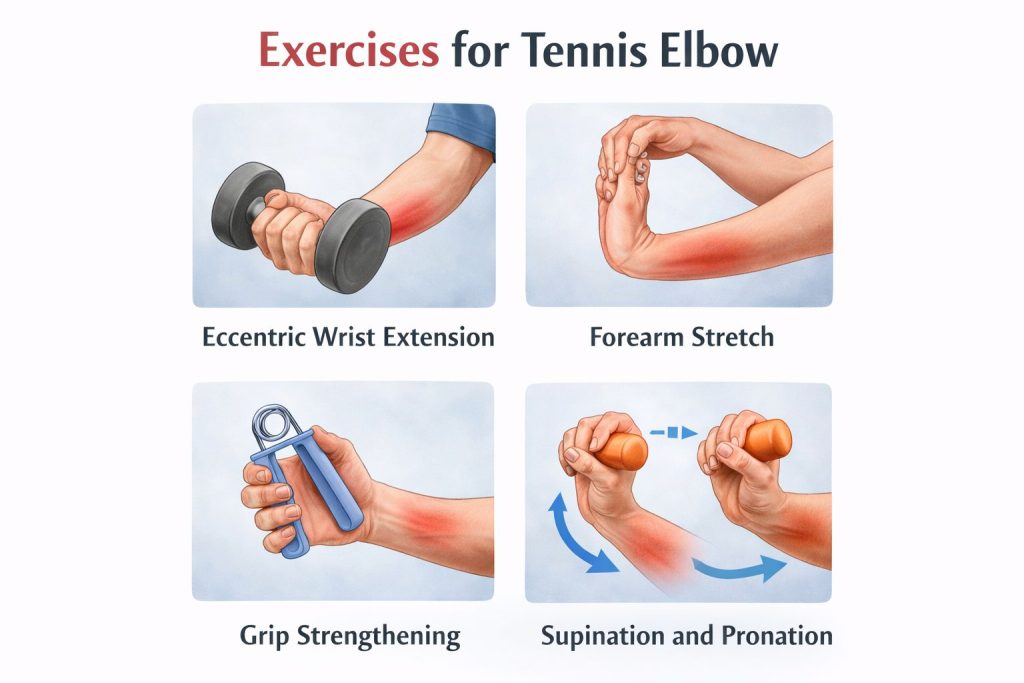
Targeted rehabilitation exercises play an important role in the recovery of tennis elbow, also known as lateral epicondylitis. The condition often develops when the wrist extensor tendons become overloaded and irritated from repetitive gripping, lifting, or twisting motions. Strengthening and stretching exercises help restore tendon capacity, improve forearm muscle balance, and reduce strain on the lateral elbow during daily activities.
Research published in journals has shown that progressive loading exercises, particularly eccentric strengthening of the wrist extensor muscles, can significantly improve pain and functional outcomes in patients with tennis elbow. These exercises help stimulate tendon remodeling and improve the tendon’s ability to tolerate stress over time.
Common rehabilitation exercises include eccentric wrist extensions, forearm stretching, and grip strengthening exercises designed to gradually restore strength and endurance in the forearm muscles. When performed consistently and progressed appropriately, these exercises can help reduce pain, improve grip strength, and support long-term recovery.
At Nottinghill Family Wellness Centre, patients in Oakville often receive individualized exercise programs designed to safely strengthen the forearm and support healing of the affected tendon.

DOWNLOAD TENNIS ELBOW STRETCHES
Our chiropractors have put together a simple plan of stretches and exercises to help speed up the recovery process. These exercises can be completed on a daily basis, and will target the affected muscles. Building up strength in the wrist extensors is a critical part of recovery, both to reduce pain and prevent the condition from returning.
Do You Need X-rays or Ultrasounds for Tennis Elbow
Possibly, imaging/tests may be used to rule out other causes (arthritis, neck-related pain, nerve compression). Tennis elbow can be intense, leading some patients to consider imaging, but it’s usually unnecessary. Our Oakville tennis elbow experts can assess the condition through orthopedic tests and a detailed history without imaging. They typically begin with conservative care before recommending an ultrasound or blood work.
If there’s no significant improvement after 8–14 treatments, you’ll be referred to your doctor for an ultrasound to rule out other conditions or explain delayed healing.
Once you are at the clinic our treatment experts will determine your actual diagnosis. Most Tennis Elbow cases are straight forward. However, some are more complicated and the elbow pain could be coming from the patients neck.
How Long Does Tennis Elbow Take To Heal?
Typical recovery:
• mild: 4–6 weeks
• moderate: 6–12 weeks
• chronic: 3–6 months
However, NHS Fife notes pain often lasts 6–12 weeks, but also that tennis elbow is often self-limiting with spontaneous improvement in ~80–90% over 1–2 years, and can last several years in severe cases.

Tennis Elbow vs Golfer’s Elbow
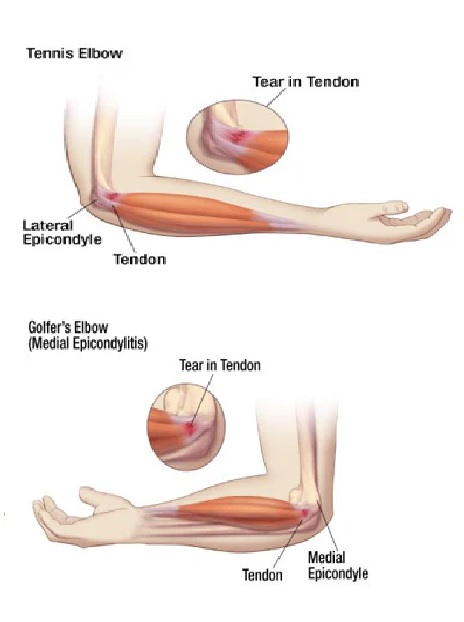
Tennis elbow and golfer’s elbow are both common causes of elbow pain, but they affect different tendons and areas of the joint. Tennis elbow, also called lateral epicondylitis, causes pain on the outside of the elbow where the forearm extensor tendons attach.
It is commonly triggered by repetitive gripping, lifting, or wrist extension activities. Golfer’s elbow, known as medial epicondylitis, affects the tendons on the inside of the elbow that control wrist flexion and gripping motions.
While both conditions involve tendon irritation from overuse, the location of pain and the muscles involved are different, which is why a proper diagnosis is important for effective treatment.
If the pain you’re experiencing is not located on the outside of your elbow, but rather on the inside, it’s likely that you have Golfer’s Elbow.

Bracing and Icing for Tennis Elbow
Ice is a crucial part of rehabilitating lateral epicondylitis. This condition involves inflammation of the common extensor tendon of the elbow, and ice helps reduce this inflammation by constricting blood vessels and promoting the removal of excess fluid. Apply ice to the area of your elbow or forearm, focusing on the thumb side. Use the 20-20-20 rule: 20 minutes on, 20 minutes off, 20 minutes on. Repeat this cycle 1-3 times a day. Always wrap the ice in a thin towel to protect your skin from frostbite.
Our team recommends that all patients with tennis elbow invest in both a Tennis Elbow Brace and a Wrist Guard. Wear the Tennis Elbow Brace during any arm or hand activities throughout the day, including during your work shift if you have a desk job. Be sure to remove the brace at night.
For optimal recovery, wear the Wrist Guard while you sleep. This brace helps prevent wrist flexion during sleep, allowing the irritated tendons to heal without further strain. It does not need to be worn during the day.
Tennis Elbow Oakville FAQS
- Can I have tennis elbow even though I do not play tennis?
- How to cure tennis elbow quickly?
- Will tennis elbow go away on its own?
- What is the best exercise for tennis elbow?
- Can I get tennis elbow and golfers elbow at the same time?
- What’s the difference between Tennis Elbow and Golfers Elbow?
- What not to do with tennis elbow?
- Should I ice or heat tennis elbow?
Yes, tennis elbow can be caused by all kinds of movements including, racket sports, computer use, baseball, yard work and really any type of repetitive work.
Get treatment ASAP. Shockwave Therapy and icing will help very fast. Get a quality tennis elbow brace and wear when doing activities.
Possibly, however tennis elbow can be very persistent. Start with ice and a brace. If the pain continues seek treatment.
Stretching your wrist and forearms along with a quality tennis elbow brace.
Yes, its like getting two flat tires on the front of your car.
Tennis elbow is when the pain is on the thumb side of the elbow/forearm. Golfers elbow is pain on the pinky or inside of the elbow.
Do not do repetitive motions that pain the area. Heavy lifting and grasping should be limited. Even pooring a coffee, opening a door could cause the elbow pain and should be modified.
Ice the injury as the “stuck” tissue is most likely causing inflammation.
Lifestyle Changes for Tennis Elbow
Tennis elbow often develops from repetitive strain on the forearm muscles and tendons, so modifying certain daily activities can help reduce stress on the elbow during recovery. Reducing repetitive gripping, heavy lifting, and prolonged wrist extension can help prevent further irritation of the tendon. Many patients benefit from improving workplace ergonomics, adjusting keyboard or mouse positions, and taking regular breaks during repetitive tasks.
When exercising or playing sports, using proper technique and gradually increasing training intensity can also reduce the risk of tendon overload. Strengthening the forearm, shoulder, and upper back muscles may help distribute forces more evenly through the arm. Small changes to daily activities can help reduce strain on the elbow and support the healing process.
For pickleball and tennis players, the plan also needs to account for gripping, hitting and how much court time the elbow can tolerate. Explore our sports injury assessment and rehabilitation approach with Dr. Steve and Dr. Alex.
Download Tennis Elbow Stretches!
Why Tennis Elbow Keeps Coming Back
Tennis elbow can sometimes return if the underlying causes of tendon strain are not fully addressed. The condition develops when the forearm extensor tendons are repeatedly overloaded, and if those stress patterns remain the same, the tendon may become irritated again even after symptoms improve.
Common factors that contribute to recurring tennis elbow include repetitive gripping tasks, poor lifting mechanics, prolonged computer use, and returning to sports or exercise too quickly. Weakness in the forearm, shoulder, or upper back muscles can also increase strain on the elbow tendons during daily activities.
Research in sports medicine suggests that progressive strengthening exercises and gradual return to activity are important for reducing recurrence of lateral epicondylitis. Addressing muscle imbalances, improving movement patterns, and modifying repetitive activities can help reduce ongoing stress on the tendon.
Tennis elbow is also common in pickleball, golf, racquet sports and weight training. Active patients can learn more about our sports physiotherapy for elbow injuries and progressive return-to-activity rehabilitation.
A comprehensive rehabilitation approach that includes soft tissue treatment, strengthening exercises, and activity modification is often recommended to help prevent tennis elbow symptoms from returning.
When is elbow pain a red flag?
Most cases of tennis elbow improve with conservative care, but certain symptoms should be evaluated promptly. Sudden severe pain after a fall or injury, visible deformity of the elbow, significant swelling, redness, warmth, fever, or loss of movement may indicate a fracture, joint injury, or infection and require urgent medical assessment. Numbness, tingling, or weakness in the arm or hand may also suggest nerve involvement and should be examined by a healthcare professional.
For many people with early tennis elbow symptoms, simple self-care strategies can help reduce irritation of the tendon. Temporarily reducing repetitive gripping or lifting activities, pacing tasks, and allowing the tendon time to recover are important first steps.
Short periods of icing after aggravating activities and the temporary use of a forearm brace may help reduce discomfort. Gradually reintroducing strengthening exercises and improving forearm and shoulder mechanics can support tendon recovery over time.
While many patients improve with conservative treatment, recovery timelines can vary depending on tendon irritation and activity levels.
Content Reviewed By: Dr. Steve Knighton, B.Sc., D.C. on October 16, 2026
Chiropractic License Number: 5580