Content Reviewed By: Dr. Steve Knighton, B.Sc., D.C. on October 12, 2026
Chiropractic License Number: 5580
SI Joint Treatment in Oakville
What Is Your SI Joint?
Anatomy of SI Joint Oakville (video)
SI Joint Pain Treatment (Sacroiliac Joint Dysfunction)
Best Treatment for SI Joint Pain
At our Oakville chiropractic and physiotherapy clinic, we specialize in effective, evidence-based treatment for SI joint dysfunction and pain. Our chiropractors and physiotherapists work together to provide personalized care that targets the root cause of your discomfort.
Dr. Steve Knighton, with nearly two decades of experience, has developed a unique, scientifically-backed treatment protocol for SI joint pain. After personally overcoming severe back injuries, including a near-catastrophic car accident in 2022 that left him with a broken back, Dr. Steve refined his approach by combining proven treatment techniques with his own specialized SI joint adjustment methods.
Our comprehensive treatment plan includes:
✔ Chiropractic Adjustments to restore SI joint mobility
✔ Shockwave Therapy to break down adhesions and promote healing
✔ Interferential Current Therapy (IFC) to reduce inflammation and relieve pain
✔ Targeted Exercises to strengthen and stabilize the hips and SI joints
Learn How To Stretch Your Glutes And Piriformis Here!
What Our Patients Are saying
-
Best place I’ve been to for chiro and physio…

Gregory Ellis
May 1, 2026We had an excellent experience from our very first phone call to book an appointment through to my dad’s last visit. My dad was experiencing severe episodes of vertigo, and the office was incredibly accommodating. The receiptions was awesome and booked him in on an urgent basis and, because his nausea... read more
Hiba K
August 18, 2026When I booked my first appointment with Dr. Steve, my SI was in so much pain, I couldn’t stand due to the pain and it was worse sitting down. I chose Dr. Steve just for proximity to work, and at the time desperate for some relief. Dr. Steve assured me... read more
Renee Phillips
February 6, 2025 -
Dr Steve and all the staff are excellent. He has been on point in helping us deal with some injuries and pains; shock wave therapy is a game changer. Now, all the family goes there. From injuries to posture, they are our go-to clinic. Highly recommend.
Jorge Vidal
December 7, 2024Dr.Jenn is a very caring and skilled chiropractor. She has a gentle yet highly effective touch. I have been to her for two separate issues and both have resolved nicely. I would highly recommend her to anyone. The clinic staff are very friendly and helpful as well.
Sandra Chiang
June 7, 2024Steve is a “fountain” of information and goes the extra mile to make you feel comfortable throughout the treatment
Kimberley Toppin
May 22, 2026 -
Dr. Steve is one of the humble person. He always treats you like a friend and pay attention to your problem. Moreover, he politely explains each and every problem and solutions. The staff of this clinic is also very good. All the staff greets you. When you are waiting at... read more
Sanyam Jain
August 7, 2024Really great service! Dr. Steven is very humorous and treats all your issues. The staffs are all super friendly and will check up on your health regularly. Overall very enjoyable experience.
Crystal Zhao
February 13, 2025Highly recommend - Dr. Steve is an amazing chiropractor. As a huge bonus, he gives good running advice—so come see him if you want to get into running and learn how to stay injury-free!"
Melissa R
June 13, 2026
4 Steps To Treating SI Joint Pain
1. Interferential Current Therapy(IFC)
In most cases, our SI back pain specialists utilize a combination of Suction IFC (Interferential Current Therapy) and heat to treat SI joint injuries. This scientifically proven approach helps relax the surrounding muscles, increase blood flow, and promote healing in the affected area.
At our Oakville clinic, we use vacuum suction IFC units instead of traditional sticky pads, as they provide a superior therapeutic experience. The suction method allows for deeper penetration of electrical stimulation, enhancing blood circulation and muscle relaxation. Patients often describe the IFC treatment as a deep, soothing massage, as it pulsates electrical stimulation into the SI joint and glute muscles, effectively reducing pain and stiffness.
If you’re experiencing SI joint discomfort or upper gluteal region , our expert team is here to help. Book your appointment today and take the first step toward lasting relief!

2. Shockwave Therapy For SI Joint
After IFC therapy and heat have effectively increased blood flow to the SI joint, our SI joint pain specialists utilize Shockwave Therapy to target the lumbar spine and glute muscles. Shockwave Therapy is a cutting-edge, air-powered treatment that delivers up to 15 pulses per second, totaling 1,200 to 1,500 targeted pulses per session. The intensity is carefully adjusted to match the patient’s pain tolerance, ranging from 0.3BAR to 8.0BAR.
This scientifically proven therapy is unparalleled in its ability to break down scar tissue, loosen tight muscles, and stimulate new blood vessel formation—enhancing long-term healing and pain relief like no other modality.
If you’ve been to our clinic before, you know how meticulous Dr. Steve is about his shockwave machines and their performance. Unlike many other clinics, he uses a superior applicator head, capable of penetrating up to 55mm into the tissue to maximize healing and recovery.
If SI joint pain is limiting your mobility and quality of life, it’s time to experience the most advanced treatment available. Book your appointment today and start feeling better, faster!

3. Active Release Therapy and Trigger Points
After Shockwave Therapy, our SI joint pain specialists utilize Active Release Therapy (ART) and Trigger Point Therapy to further relieve tension and restore mobility in the affected muscles.
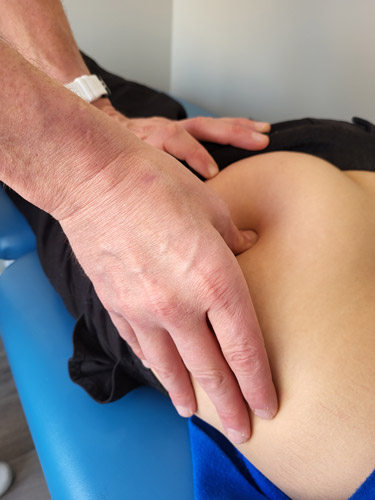
During ART, our healthcare professionals apply targeted pressure to tight muscles while simultaneously moving the hip or lower spine through specific ranges of motion. While this technique can be mildly uncomfortable, it is highly effective in breaking up adhesions, loosening tight muscles, and improving flexibility around the SI joint.
Trigger Point Therapy, similar to ART, involves direct pressure on knotted or tight muscles in the glutes, and surrounding areas. Our practitioners focus on key muscles such as the piriformis, quadratus lumborum (QL), and gluteal muscles, which often contribute to SI joint dysfunction and pain. In some cases, our doctors will have patients lie on their back to perform Trigger Point Therapy and ART on the hip flexor muscles, ensuring a comprehensive approach to pain relief and mobility restoration.
4. Chiropractic Adjustment for the SI Joint
What truly differentiates our Oakville clinic from others is the comprehensive preparation we perform before a manual chiropractic adjustment of the SI joint. Rather than rushing into an adjustment, our specialists first use a combination of Interferential Current Therapy (IFC), heat therapy, Shockwave Therapy, and Active Release Therapy (ART). These scientifically backed techniques work together to loosen up the stiff joint, relax the surrounding muscles, and maximize the effectiveness of the SI joint adjustment.
At our clinic, SI joint adjustments are performed exclusively by our experienced chiropractors. During the procedure, the patient is positioned on their side, and the chiropractor gently bends the knee toward the chest while applying a controlled rotational force to the spine, delivering a precise and effective SI joint adjustment.
Dr. Steve Knighton, known as one of the highest-rated chiropractors in Ontario, has developed his own modified technique for SI joint adjustments. His method has helped thousands of patients experience lasting relief from SI joint pain and regain full mobility.

Glute Pain Treatment and SI Joint
Why do my bum muscles hurt?
Your gluteal muscles play a vital role in stabilizing your pelvis and supporting your pelvis and SI joint. The three primary muscles—Gluteus Maximus, Gluteus Medius, and Gluteus Minimus—work together to ensure proper movement, posture, and overall spinal health. However, when these muscles become weak, inactive, or excessively tight, they can directly contribute to acute and chronic SI joint pain.
At our Oakville clinic, Dr. Steve Knighton and his expert team specialize in identifying and treating glute dysfunction and SI joint disorders. Some patients struggle with pain and stiffness due to tight, overactive glutes, while others suffer from poor glute activation, leading to instability, compensation patterns, and strain in the SI joints. The reality is, you can’t have an SI joint issue without a glute issue.
If you’ve been treated by Dr. Steve, you know firsthand the intensity and effectiveness of his hands-on deep tissue techniques. His evidence-based treatments, including shockwave therapy, specifically target deep-seated muscular adhesions in the glutes and surrounding structures. These advanced techniques help break down scar tissue, improve circulation, restore function, and—most importantly—pinpoint exactly where your muscles need treatment to provide lasting relief.
Pain around the SI joint can feel similar to pain involving the lumbar spine, gluteal muscles or the thoracolumbar junction. Doctor Steve and Doctor Alex assess those nearby areas when the history and movement findings point beyond the SI region. Learn more about pain referred from the thoracolumbar junction.

SI Joint Pain vs. Sciatica
SI joint dysfunction can cause pain in the lower back, buttock and thigh, sometimes resembling sciatic nerve irritation. True sciatica more commonly involves pain, tingling or numbness travelling farther down the leg.
Learn how we assess sciatica and radiating leg pain in Oakville.
Best Exercises To Stop SI Joint Pain
The Bridge Exercise for SI Joint Pain
- Lay on your back with your hands by your sides, your knees bent and feet flat on the floor. Make sure your feet are under your knees.
- Tighten your abdominal and buttock muscles.
- Raise your pelvis up to create a straight line from your knees to your shoulders.
- Squeeze your core and try to pull your belly button back toward your spine. The goal is to maintain a straight line from your shoulders to your knees and hold for 20 to 30 seconds.


The Clam Exercise for SI Joint Pain
- While lying on your side, keep both knees bent and flex the pelvis to 30 degrees.
- While keeping your heels touching and pelvis still, open your knees by contracting your glute medius. This is a very slow, small and targeted movement.
- Place your hand on your gluteus medius (just below and behind your hip) to ensure that it is firing during the movement.
- Repeat the movement slowly 10 to 15 times and switch sides.
The Single Leg Bridge Exercise
- Lay on your back with your knees bent and your feet are under your knees.
- Tighten your abdominal and buttock muscles and slowly lift your pelvis up to create a straight line from your knees to shoulders.
- Slowly raise and extend one leg while keeping your pelvis raised and level. If your pelvis sag or drop, place the
- leg back on the floor and do a double leg bridge until you become stronger.
- Hold to position for 10 seconds and lower. Repeat with the opposite leg.


The Quadruped Extension Exercise
- Start in a quadruped position (on your hands and knees).
- Tighten your core and contract your abs to stabilize the spine.
- Focus on contracting the left glut. You may need to place your hand on your glut to be sure it contracts.
- Slowly lift the left leg up while keeping a 90-degree bend at the knee.
- The left thigh should be nearly parallel with the ground.
- Slowly lower to the start position and repeat 10 reps per side.
- To increase the intensity of this exercise, place a small dumbbell behind your knee or add an ankle weight.
Once you have healed your SI Joint. Try these at home exercises to support your treatment:
For help with pain or discomfort please contact our physiotherapy and chiropractic clinic in Oakville at 905-827-4197 OR

Acupuncture for Glute Pain and SI Joint treatment
Here we go, talking about acupuncture again at our Oakville clinic. But it works like a charm! The three glute muscles can also send pain into the butt and even down the legs if they get really tight. A great way to get to the glute min and med, that lay underneath the larger glute max muscle is via acupuncture. The needles are great at getting deep down into the muscles and creating a change in the tension and activation efficiency of the muscle.
If your muscles are too tight, the needles will draw more blood flow the area and help the muscles relax and release. The great thing about this is that you won’t even feel the needles go in. It’s a pain free experience that gets amazing results. As mentioned above, muscle imbalances can also cause glute and SI joint pain. Inserting needles into ‘sleepy’ muscles that need to wake up and activate better can also create positive change in this painful position.
Our chiropractor and acupuncture provider, Dr. Jenn, can also insert some muscles into the joints themselves. With patients laying face down, and a pillow under their pelvis, this opens up the joints in the back. Small needles can be placed into the SI joints, right around the area of the ‘back dimples’. These needles stimulate the healing response and lead to a quicker recovery time.
SI Joint Pain Treatment FAQs
- What does SI stand for?
- Is low back pain the same as SI Joint pain?
- What are the causes of SI Joint pain?
- What are the symptoms of SI Joint pain?
- How to make SI Joint pain go away?
- What is the best treat sacroiliac joint pain?
- Should I see a physiotherapist or a chiropractor for SI joint pain?
- How is SI Joint pain treated?
- What exercises should I NOT do with SI Joint pain?
SI stands for Sacroiliac Joint. Its the dimples on each side of your low back right above your bum. SI Joint Pain Dysfunction is the most common diagnosis of low back pain at our Oakville clinic.
Yes, SI joint pain causes low back pain. But SI Joint Dysfunction is one of many diagnosis’ a patient can have with low back. It is the most common diagnosis in our clinic for low back pain though.
SI joint pain occurs when the SI joint moves slightly out of place. This could be from inactivity or sitting to much. SI Joint pain could be caused from poor posture, week core muscles, traumas, injuries, snow shoveling, sneezing. In our Oakville chiropractic clinic we do find most patients with chronic SI joint pain have an anterior pelvic tilt.
SI Joint dysfunction can present as very mild pain in the low back to 10 out of 10 excruciating pain and stiffness. In most cases it does focus on one side of the low back and patients have a hard time walking up stairs or lifting there knee to their chest while standing.
Treatment and posture exercises are the best for making SI joint pain go away. A chiropractor who adjusts SI joints manually is the best option. Treatment should include shockwave, ART, adjustments and exercises and stretches.
The best treatment for SI joint pain is a combination of Shockwave Therapy and Diversified Chiropractic adjustments.
We would recommend seeing a chiropractor who manually side posture adjusts your SI joint. Combine this with physiotherapy modalities like shockwave, Graston and ART and you will be on the right path to healing.
SI joint pain should be treated by a therapist with knowledge of the condition. They should be treating around the SI joint, into the glutes, piriformis, ITB, psoas muscles. Make sure you get the proper diagnosis before starting any treatment.
Do not do anything that causes SI joint pain while you are still healing. Planks, although helpful, might flare up the SI Joint early on in recovery. Watch out for deadlifts, leg presses, squats and anything with flexion rotation.
Content Reviewed By: Dr. Steve Knighton, B.Sc., D.C. on October 12, 2026
Chiropractic License Number: 5580