Author and Content Reviewed By: Doctor Steve Knighton, B.Sc., D.C.
The popliteus is a small, deep muscle at the back of the knee. It helps “unlock” the knee from a fully straight position, controls rotation of the tibia and contributes to knee stability. Popliteus muscle pain is a major cause of back of the knee muscle strains!
At our Oakville clinic, Doctor Steve has been treating knee and sports injuries for nearly 20 years.
Typical popliteus pain is aggravated by walking downhill, going downstairs, running, pivoting, twisting or bending the knee after it has been fully straight.
Ask the average person what a popliteus is and they will probably guess it was a boy band from the 1980s. It isn’t. But it is a muscle that gets missed surprisingly often. When people ask what muscle is behind the knee? Most times its the popliteus muscle.
Doctor Steve has been treating knee and sports injuries for nearly 20 years. We have seen patients arrive after months of assuming they had a meniscus problem when their examination showed that the popliteus was contributing to their pain.
The important part is not simply deciding that every pain behind the knee is a popliteus strain. It isn’t. Meniscus injuries, Baker’s cysts, hamstring or calf injuries, ligament injuries and several other conditions can produce pain in the same area. That is why the assessment comes first.
What muscle is behind the knee? The popliteus is a small muscle behind the knee that helps unlock the joint as you begin bending it. Other muscles behind the knee include the gastrocnemius and portions of the hamstrings.
Many of patients present with pain in their knee of no specific origin. It could be worse with walking, standing or even sitting. After our chiropractor determines their injury is not structural and is the popliteus muscle treatment will begin immediately. We recommend Oakville custom orthotics or more supportive footwear for most of our knee pain patients.
What Is the Popliteus Muscle?
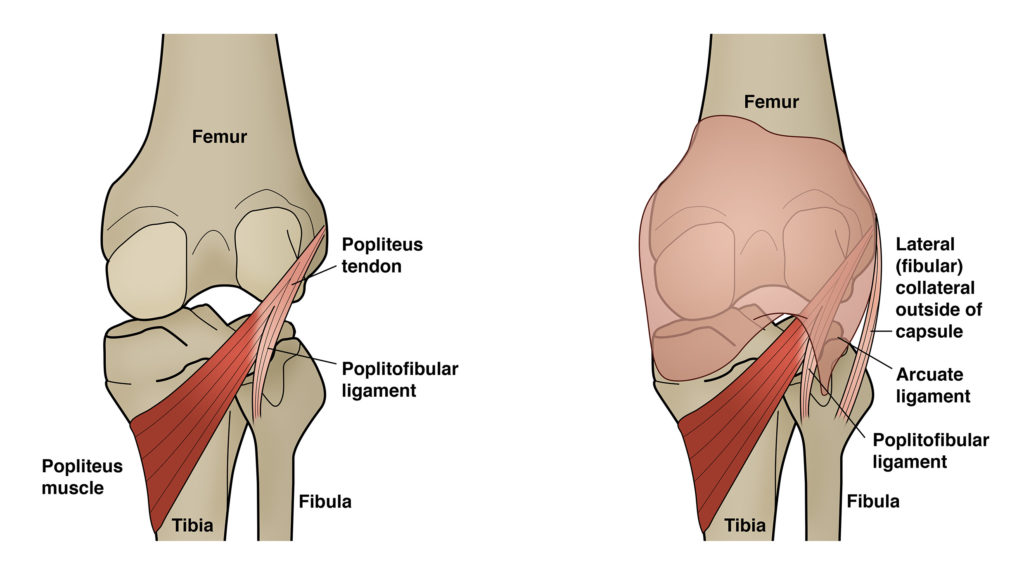
The popliteus is a small triangular muscle located deep behind the knee. It runs from the lateral side of the femur toward the back of the tibia. Ironically, it sits above the popliteal fossa.
Despite its size, it has several important jobs:
- Helps unlock the knee as you begin bending it from a fully straight position
- Helps control rotation between the tibia and femur
- Assists with knee flexion
- Contributes to posterolateral knee stability
- Helps control the lateral meniscus as the knee moves
You can read more about the anatomy and function of the popliteus muscle through the National Library of Medicine.
Because the popliteus works during walking, running and rotational movements, irritation is often particularly noticeable during stairs, downhill walking and sports that involve cutting or changing direction.
What Does a Popliteus Muscle Injury Feel Like?
Popliteus pain is usually felt deep in the back of the knee or slightly toward the outside of the back of the knee.
Patients commonly describe:
- A deep ache behind the knee
- Tenderness near the upper calf/back of the knee
- Pain when first bending a completely straight knee
- Pain walking downhill or downstairs
- Pain with pivoting or twisting
- Pain during or after running
- Tightness at the back of the knee
- Discomfort after prolonged standing or walking
- A feeling that the knee is not moving normally
Some patients have difficulty pointing to one exact painful spot because the muscle sits fairly deep.
Why Does the Popliteus Hurt?
There is not one single cause of popliteus pain.
We commonly see a combination of overload, sudden twisting, running volume, downhill activity, knee hyperextension, direct trauma and altered lower-extremity mechanics.
A popliteus problem can develop gradually from repetitive stress or appear following a specific injury.
Popliteus Strain
A strain involves injury or overload of the muscle or musculotendinous tissue. Symptoms often begin after a sudden twist, awkward step, sports injury or increase in training.
Popliteus Tendon Pain and Tendinopathy
Persistent loading of the popliteus tendon can produce a more gradual pattern of pain. People commonly search for this as popliteus tendinitis, popliteus tendonitis or popliteus tendinopathy.
The terminology varies, but the bigger clinical question is whether the symptoms are coming from the popliteus and what is causing it to remain irritated.
Tight or Overworked Popliteus Muscle
Not every painful popliteus is torn. Sometimes the muscle is simply working harder than it should because of changes elsewhere in the leg.
That is why we look beyond the sore spot and assess the knee, hip, ankle, gait and footwear when appropriate.
Popliteus Pain vs Other Causes of Pain Behind the Knee
This is one of the most important parts of the page.
Pain behind the knee does not automatically mean you injured your popliteus.
Posterior knee pain can also come from the meniscus, hamstring tendons, gastrocnemius, ligaments, a Baker’s cyst and other structures. Less commonly, vascular or neurological conditions can produce symptoms in the same region.
A proper assessment becomes especially important when there is significant swelling, a traumatic injury, locking, instability or symptoms that do not behave like a straightforward muscle or tendon problem.
For a detailed medical overview of posterior knee pain and its possible causes, see this review through the National Library of Medicine.
If you have sudden calf swelling, redness or warmth, significant unexplained swelling behind the knee, shortness of breath, fever, inability to bear weight or a major traumatic injury, seek appropriate medical assessment rather than assuming it is a popliteus strain.
Treatment for Knee Pain Oakville
How Do We Diagnose Popliteus Pain?
There is no magic single test that proves the popliteus is responsible.
At our clinic we start by finding out exactly where the pain is, how it started and which movements reproduce it.
The examination includes knee range of motion, resisted movement, tibial rotation, strength testing, functional movements and palpation of the muscles and tendons around the back of the knee.
We also look for signs that point somewhere else.
That distinction matters. Treating the popliteus for six weeks when the actual problem is a meniscus injury or Baker’s cyst isn’t particularly useful.
X-rays do not show the popliteus muscle itself. MRI is useful when a significant popliteus injury, associated ligament injury or another internal knee problem is suspected, but every uncomplicated case does not automatically need imaging.
For more general information about other sources of knee pain, see our Oakville knee pain treatment page.
How Do You Treat Popliteus Pain?
Treatment depends on whether we are dealing with an acute strain, persistent muscle irritation, tendon pain or a more complicated knee injury.
In straightforward cases, treatment revolves around 3 things:
Calm the irritated area, restore comfortable knee movement and progressively reload the leg.
Simply rubbing the painful spot forever isn’t much of a rehabilitation plan.
Early on, that often means temporarily reducing running, downhill walking, deep loaded knee movements or whatever repeatedly reproduces the pain.
As symptoms settle, movement and strength are progressively rebuilt.
Popliteus Tendinitis Treatment
When our examination shows that the popliteus is contributing to the patient’s knee pain, treatment is individualized rather than automatically doing the same four things to everyone.
We combine hands-on treatment, exercise and supportive therapies based on what we find during the examination.
1. IFC and Heat
When the back of the knee is sore and guarded, we start treatment with heat and IFC therapy to settle the area before deeper hands-on treatment.
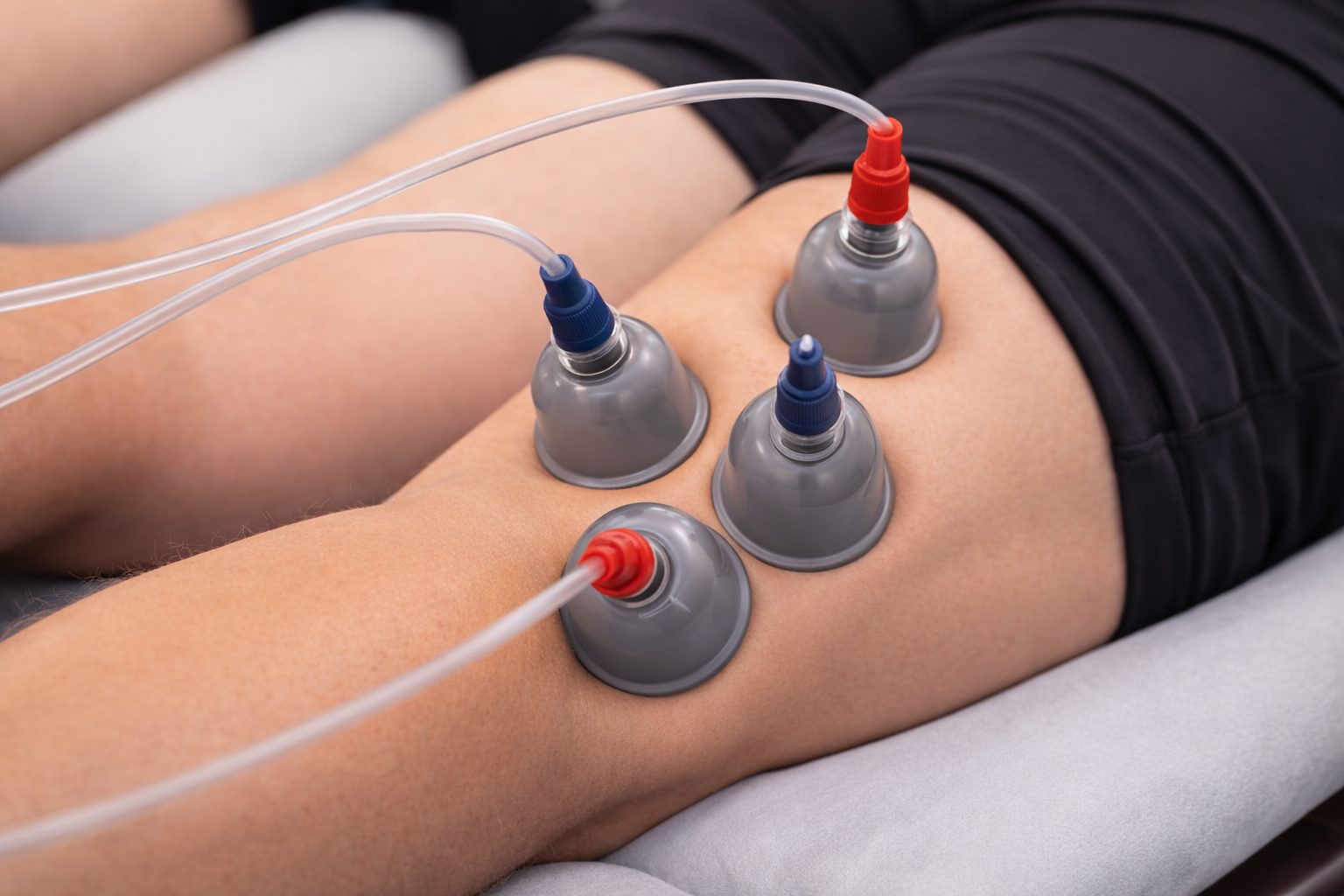
At our clinic, IFC is applied with comfortable suction-cup electrodes.
The goal at this stage is simple: decrease pain, improve circulation to the area and make movement and treatment more comfortable.
IFC is one part of the treatment. We do not put four suction cups on someone’s knee and pretend an electrical machine has magically fixed why the problem developed.
Heat helps:
-
Relax the popliteus muscle
-
Increase blood flow
-
Loosen tight tissue
IFC (Interferential Current) is a gentle electrical stimulation that:
-
Improves circulation
-
Reduces swelling
-
Calms irritated tissue
-
Helps your body begin healing
We do this first so the popliteus muscle is relaxed before deeper treatment begins.
This step makes the rest of your popliteus treatment more effective and more comfortable.
2. Shockwave Therapy for Popliteus Pain in Oakville
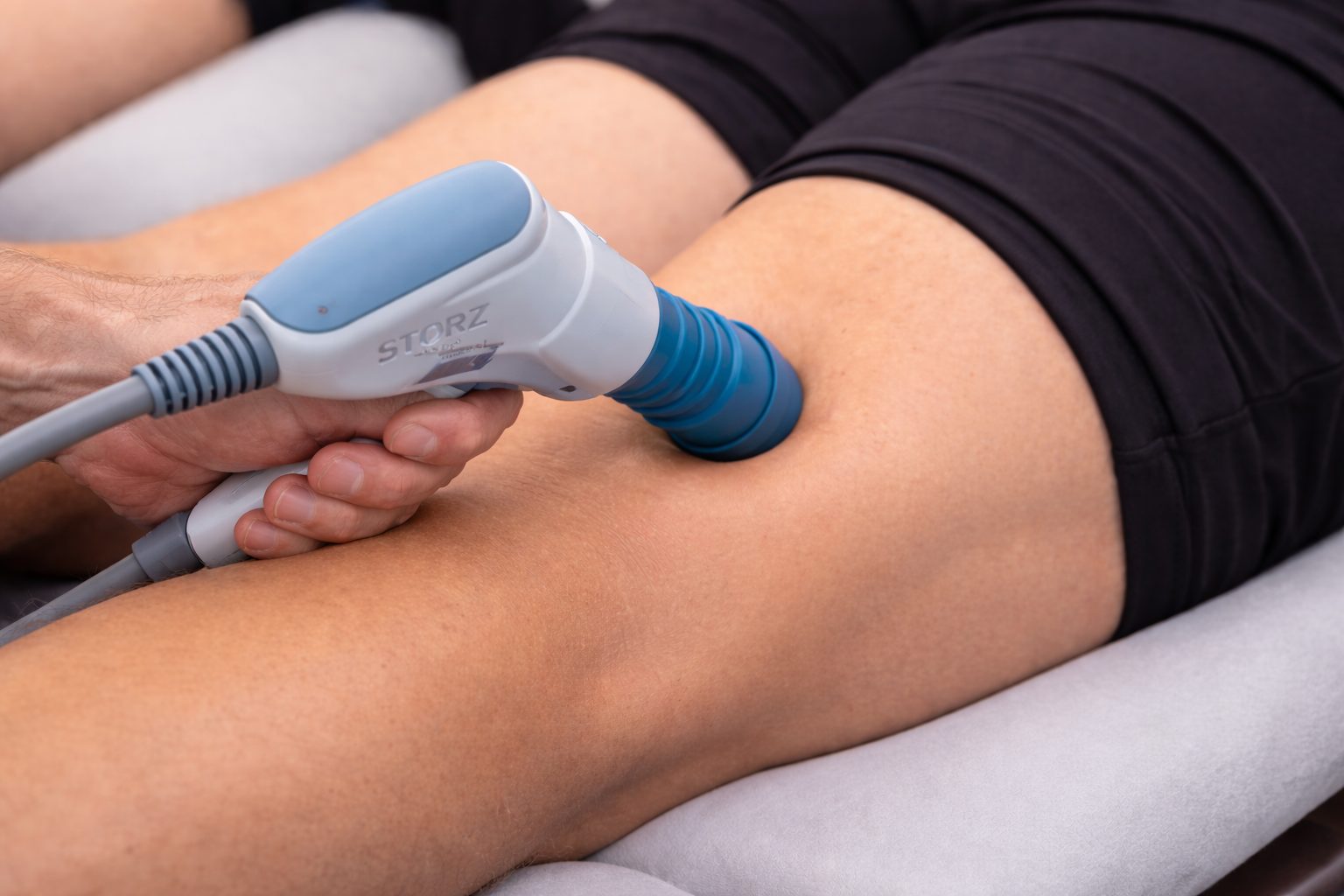
Dr. Steve shockwave therapy for persistent popliteus tendon and soft-tissue injuries when the examination shows that shockwave is appropriate.
Shockwave delivers mechanical acoustic pulses into the injured tissue and is used in the treatment of chronic tendon and soft-tissue conditions.
Research specifically on isolated popliteus injuries is limited, so we combine what the research tells us about tendinopathy and soft-tissue treatment with what we find clinically.
The back of the knee contains important nerves and blood vessels, so this is not a “just point the shockwave gun at the middle of the knee and fire away” situation. We identify the involved tissue and apply treatment directly and carefully.
You can also review the International Society for Medical Shockwave Treatment recommendations.
-
Scar tissue
-
Poor blood flow
-
Chronic tightness
The popliteus is a small, deep muscle that helps unlock the knee and control rotation. Because it has limited blood supply, it can be slow to heal on its own. Shockwave “restarts” the healing process.
Treatment lasts about 2–3 minutes and targets the exact tight area.
We use Shockwave Therapy as part of our structured popliteus treatment plan in Oakville to speed recovery and restore proper knee mechanics.
3. Active Release Technique (ART) for Popliteus Dysfunction
This is one of the areas where hands-on treatment can be particularly useful.
The popliteus is small, deep and very specific. We use targeted soft-tissue techniques such as Active Release Technique (ART) to treat the popliteus and surrounding tissues.
ART is not simply a general massage. Specific pressure or tension is applied while the knee is guided through controlled movement.
The goal is to reduce excessive muscle guarding, improve comfortable tissue movement and restore normal knee mechanics.
We also assess and treat the calf, hamstrings and other structures around the knee when they are contributing because the popliteus does not work in isolation.
4. IASTT for Popliteus Scar Tissue and Tightness
We also use IASTT — Instrument Assisted Soft Tissue Therapy around the involved muscle and surrounding soft tissue when stiffness and tissue sensitivity are restricting movement.
The goal is to improve tissue mobility and comfortable movement while the rehabilitation program gradually restores strength and capacity.
We are not trying to beat the hell out of a sore muscle because it hurts. More aggressive does not automatically mean better.
5. Exercises and Progressive Rehabilitation
This becomes increasingly important as pain settles.
A good rehabilitation program progresses from comfortable knee movement toward strength, balance and eventually whatever the patient actually needs to do — walking, stairs, running, soccer, skiing or simply getting through a workday without the knee complaining.
Patients who need more structured rehabilitation can also be assessed and treated by our Oakville physiotherapy team.
Popliteus Exercises
There isn’t one magical “popliteus exercise.”
Rehabilitation restores the function of the entire leg, because the popliteus works with the quadriceps, hamstrings, calf, hip muscles and other knee stabilizers.
Early exercises include gentle knee flexion and extension such as heel slides and comfortable range-of-motion work.
As pain settles, rehabilitation progresses toward controlled tibial rotation, calf strengthening, quadriceps strengthening, hip strengthening, balance work and eventually step-downs or sport-specific loading.
A useful rule is that exercise should feel controlled rather than sharp. Mild muscular effort is one thing. Repeatedly reproducing sharp pain behind the knee is another.
How Do You Stretch the Popliteus Muscle?
This one gets searched constantly, but the answer isn’t as exciting as people want it to be.
There is no perfect isolated popliteus stretch in the same way that you can easily stretch your calf or hamstring.
The muscle is deep and its main functions involve knee rotation and unlocking the knee. Gentle knee mobility together with appropriate calf and hamstring mobility works well when those structures are also tight.
Forcing the knee aggressively into extension or rotation because you are trying to “stretch the popliteus” can simply irritate an already sore knee.
Can Footwear or Orthotics Affect Popliteus Pain?
Yes, in the right patient.
Foot and ankle mechanics influence rotation throughout the lower extremity. If excessive pronation, poor footwear or another mechanical issue is increasing rotational stress at the knee, changing footwear or using custom orthotics becomes part of the overall treatment plan.
But we do not automatically prescribe orthotics because somebody has a sore popliteus.
We assess first. If the feet are contributing to the problem, we address them. If they aren’t, we don’t.
How Long Does a Popliteus Strain Take to Heal?
There is no reliable one-size-fits-all recovery time.
A mild overloaded or irritated popliteus often improves relatively quickly once the aggravating activity is reduced and normal movement is restored.
A more significant muscle strain, tendon injury or injury involving other structures of the posterolateral knee takes considerably longer.
The important signs are whether pain is steadily decreasing and whether walking, stairs, knee motion and strength are returning.
If you have been waiting several weeks and absolutely nothing is changing, that is a pretty good reason to have the knee assessed rather than continuing to guess.
Can You Run With Popliteus Pain?
It depends on how irritated it is.
If running causes pain during the run, changes your stride or leaves the back of the knee noticeably worse afterward, continuing the same running volume usually isn’t helping.
That doesn’t automatically mean complete inactivity.
Cycling, swimming and other lower-impact activities can maintain fitness while the knee settles, provided they do not reproduce the pain.
Return to running should be progressive. Walking, stairs and basic strengthening should be reasonably comfortable before trying to hammer out your normal running distance again.
If pain behind your knee keeps returning with running, soccer or quick changes of direction, an assessment can help clarify what is being irritated. Our Oakville sports chiropractic team looks at your symptoms alongside training volume and the movements your sport requires.
A Popliteus Case From Our Oakville Clinic
One case that has always stuck with Doctor Steve involved a 23-year-old NCAA soccer player who was home for the summer.
She had been receiving ongoing treatment for knee pain through her university program, but the pain at the back of the knee was continuing.
When we assessed her, the popliteus had not really been considered.
Her treatment focused on the findings from the examination and included targeted manual therapy, IFC, knee mobilization and progressive activity management. After several treatments, her symptoms had improved substantially.
That doesn’t mean every case responds the same way. It does illustrate something we see regularly: sometimes the difficult part isn’t treating the painful structure — it is figuring out which structure is actually causing the pain.
Read more about popliteus knee pain HERE
For help with pain or discomfort please contact your local chiropractor in Oakville at 905-827-4197
Book An Popliteus Treatment Appointment
Popliteus Pain FAQs
What is the popliteus muscle?
The popliteus is a muscle on the back of the knee that helps lock the knee out when you are standing with your legs straight.
What causes popliteus pain?
Popliteus pain could be caused from hyperextension of the knee, standing too long, walking to much or even lifting weights.
What are the symptoms of popliteus pain?
The popliteus muscle pain is usually right at the top of the calf or behind the knee. It can mimic a meniscus tear in some patients. It could be pain when standing or lying with a straight leg then bending the knee.
How can I treat popliteus pain?
Popliteus treatment is best with Graston and shockwave therapy. Shockwave is the gold standard for treating the popliteus and will be combined with ART and Graston in most cases.
When should I seek treatment for popliteus pain?
Seek treatment immediately after you feel pain or severe stiffness in the back of your knee.
Is my popliteus pain cause pain when walking downstairs?
It could be. When you lock out your leg at the bottom of a step it could be the popliteus muscle causing your knee pain.
What is causing the pain at the back of the my knee?
The popliteus can definitely be the cause of the pain at the back of your knee. Get into our Oakville clinic today and get the proper diagnosis.
Can my shoes cause my popliteus pain?
Yes, shoes that do not offer enough control can cause knee pain.
What exercises can I NOT do with popliteus pain?
Do not do heavy squats or deadlifts with popliteus pain. Limit machines that cause your leg to lock out too, like knee extension or calf raises.
Can I run with popliteus pain?
You should not run with a popliteus injury. The hard impact of the lead leg when running will cause further damage.
What does a popliteus injury feel like?
Popliteus pain is often described as a deep ache, tightness or soreness behind the knee, frequently toward the posterolateral or back-outside portion of the knee. It commonly hurts with downhill walking, stairs, running, pivoting or bending the knee from a fully straight position.
Where is popliteus pain located?
The popliteus sits deep at the back of the knee. Pain is commonly felt behind the knee or toward the upper outside portion of the calf/knee junction.
What causes popliteus pain?
Common causes include repetitive overload, running, downhill activity, sudden twisting, sports injuries, knee hyperextension and more significant posterolateral knee injuries.
How do you get rid of popliteus pain?
First determine whether the popliteus is actually the problem. Treatment includes reducing the aggravating load, restoring comfortable knee motion and progressively strengthening the leg. At our Oakville clinic we also use hands-on therapy, IFC, shockwave therapy and other treatment based on the examination findings.
How do you release a tight popliteus?
Because the popliteus is a deep muscle behind the knee, aggressively digging into the area yourself is not a great idea. We use targeted manual therapy together with controlled knee movement to treat the muscle and surrounding tissues.
How long does a popliteus strain take to heal?
Minor irritation often improves over a matter of weeks, while more significant strains, tendon injuries or injuries involving other knee structures take longer. Recovery depends heavily on the severity of the injury and how quickly normal motion and loading are restored.
Is popliteus pain worse when walking downstairs?
It can be. The popliteus helps control knee rotation and the transition from extension into flexion, which is one reason patients often notice symptoms during stairs or downhill walking.
Can popliteus pain mimic a meniscus injury?
Yes. The two can produce pain in similar regions of the knee. That does not mean every suspected meniscus problem is actually the popliteus. The examination is what separates them.
Is popliteus pain the same as a Baker’s cyst?
No. A Baker’s cyst is a fluid-filled swelling behind the knee and is different from an injured popliteus muscle or tendon. Because both can produce posterior knee pain, distinguishing between them is important.
You can read more about posterior knee pain and its differential diagnosis here.
Do I need an MRI for popliteus pain?
Usually not automatically. Many uncomplicated musculoskeletal injuries are initially assessed clinically. MRI becomes more useful when the examination points toward a significant tear, traumatic injury, instability or another internal knee problem.
Can I run with a popliteus injury?
Running through increasing pain is generally not a good strategy. If running aggravates the knee or changes your stride, reduce the load and rebuild gradually as pain, motion and strength improve.
When should pain behind the knee be assessed urgently?
Seek prompt medical assessment for sudden significant swelling, calf redness or warmth, shortness of breath, fever, inability to bear weight, a locked knee, major trauma or rapidly worsening symptoms.
Is Popliteal Fossa Pain the Same as Popliteus Pain?
Not necessarily. The popliteal fossa is the hollow behind the knee; the popliteus is one muscle in that region. Popliteal fossa pain can come from muscles, tendons, a Baker’s cyst or other structures. Doctor Steve assesses the cause before recommending treatment for pain behind the knee.
What Is the Difference Between a Popliteus Strain and Tendinopathy?
A popliteus strain involves injury to the muscle or its connection with the tendon. Popliteus tendinopathy affects the tendon and may develop gradually with repeated loading. Often searched as popliteus tendinitis treatment, care depends on the findings and may include activity changes, hands-on treatment and progressive strengthening.
Can the Popliteus Tendon Cause Snapping Behind the Knee?
Yes, a snapping popliteus tendon can cause a clicking or snapping sensation toward the outside of the knee during movement. Other tendons and meniscus problems can produce similar symptoms. Doctor Steve assesses painful or persistent snapping to determine whether rehabilitation, further imaging or specialist assessment is appropriate.
Popliteus Treatment in Oakville
Pain behind the knee, discomfort on stairs or pain with walking? Doctor Steve assesses your knee and surrounding muscles to identify what is causing the problem. Treatment can include suction IFC, Shockwave Therapy, hands-on muscle treatment and exercises tailored to your findings.
At Nottinghill Family Wellness Centre, appointments take place in private treatment rooms. We welcome new patients, offer evening appointments and are open Saturdays. Same-day appointments are available when the schedule allows, with direct billing available for many extended health insurance plans.
Call 905-827-4197 | Text 289-228-8858
Visit us at 1131 Nottinghill Gate, Oakville. Coming from Burlington, Milton or Mississauga? Our team will help find an appointment that fits your schedule.