Content Reviewed By: Dr. Steve Knighton, B.Sc., D.C. on October 12, 2026
Chiropractic License Number: 5580
Arm Pain, Forearm Pain, Numbness & Tingling Treatment in Oakville
Arm pain, forearm pain, numbness and tingling can come from the muscles, tendons, joints or nerves anywhere from the neck and shoulder down to the wrist and hand. At Nottinghill Family Wellness Centre in Oakville, the first thing we do is figure out where the pain is actually coming from. Once we know that, the treatment becomes much more straightforward.
Some patients come in with one very specific painful spot around the elbow. Others have an aching forearm, pain with gripping, weakness when lifting, burning into the hand, or numbness and tingling travelling down the arm. Those are completely different presentations and they should not all be treated the same way.
Our chiropractic and physiotherapy team assesses the arm, elbow, wrist, shoulder and neck when necessary so we can identify the likely source of the problem and treat the right area.

Where Does Your Arm or Forearm Hurt?
Where the pain is located gives us a very good starting point.
Pain around the shoulder and upper arm often comes from the shoulder itself. Rotator cuff problems, shoulder tendinopathy, bursitis, biceps irritation and other shoulder conditions can all refer pain farther down the arm.
Pain around the outside of the elbow and upper forearm is very commonly Tennis Elbow. Pain along the inside of the elbow and forearm commonly points us toward Golfer’s Elbow.
Pain lower in the forearm can come from the wrist, tendons or nerves. Common examples include Carpal Tunnel Syndrome, TFCC injuries and thumb and De Quervain’s pain.
The painful spot matters, but it does not always tell the whole story. We examine the movements and structures that reproduce the symptoms rather than simply treating whichever area hurts when you walk through the door.

Forearm Pain With Gripping and Lifting
If your forearm hurts when you grip, lift or twist something, there is a good chance the muscles and tendons around the elbow or forearm are involved.
Patients often notice this while carrying groceries, holding a coffee mug, gardening, using tools, lifting weights, playing golf or pickleball, typing, or repeatedly using a mouse.
Tennis elbow usually produces pain along the outside of the elbow that can travel into the upper forearm. Gripping, lifting and resisted wrist movements are common triggers.
Learn more about Tennis Elbow Treatment in Oakville
Golfer’s elbow affects the inside of the elbow and can produce pain down the inner forearm. You absolutely do not have to play golf to develop it. We see it from lifting, repetitive work, gym training, racquet sports and everyday overuse.
Learn more about Golfer’s Elbow Treatment in Oakville
Not every painful forearm is tennis elbow or golfer’s elbow. Repetitive strain, muscle overload and other tendon problems can produce very similar symptoms, which is why we examine the area before deciding how to treat it.
For pickleball players, golfers and people who lift weights, forearm pain can show up with very specific gripping movements. Our sports chiropractic care with Dr. Steve and Dr. Alex considers those demands when assessing the problem and recommending treatment and rehabilitation.

Arm Pain, Numbness and Tingling
When pain is accompanied by numbness, tingling, burning, heaviness or weakness, we start looking closely at the nerves.
One of the most important things patients need to understand is that the problem does not always start where you feel the symptoms.
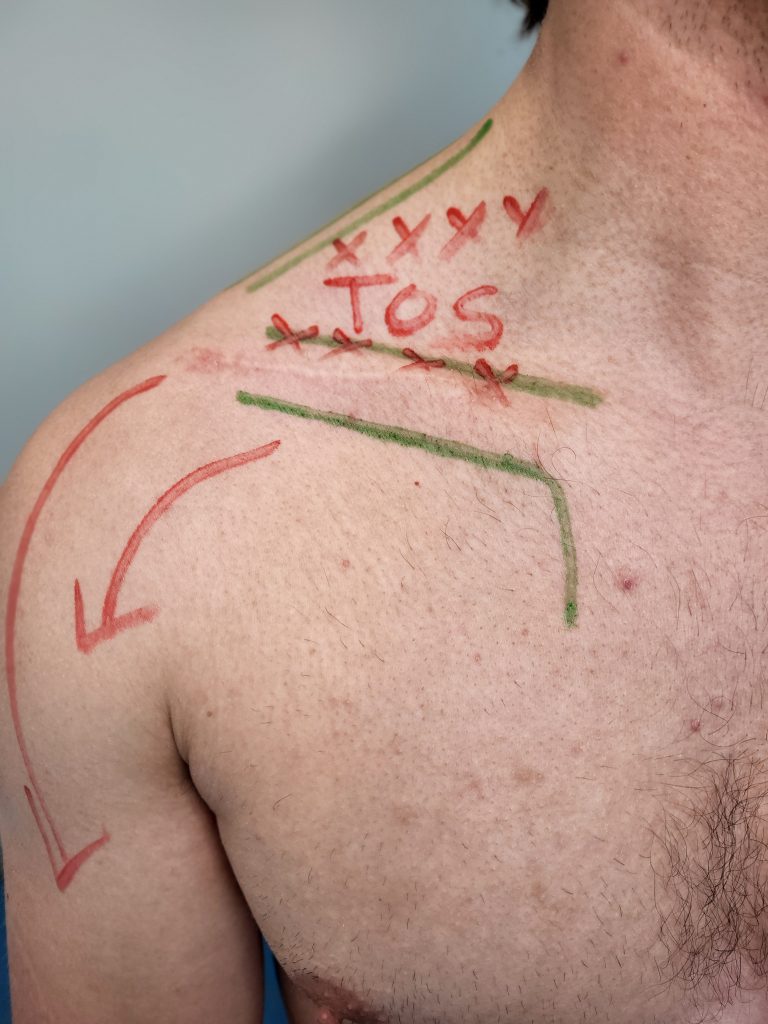
A nerve irritated in the neck can send pain, numbness or tingling through the shoulder, upper arm and forearm and sometimes right into the hand. This is commonly called cervical radiculopathy or a pinched nerve.
Learn more about Neck Pain Treatment in Oakville
Thoracic Outlet Syndrome can also create arm symptoms when nerves or blood vessels become irritated between the neck, first rib and shoulder region.
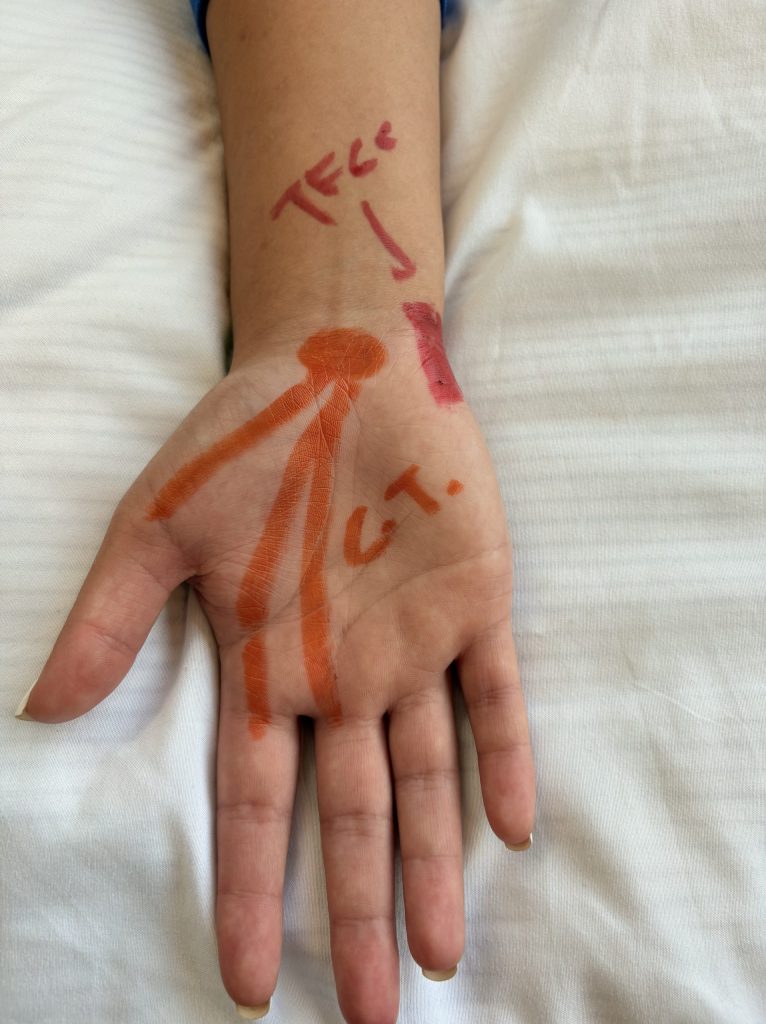
Numbness or tingling involving the thumb, index and middle fingers can point toward Carpal Tunnel Syndrome.
If you have tingling running down your arm, simply rubbing the forearm is not good enough. We need to determine whether the problem is coming from the neck, shoulder, elbow, wrist or somewhere along the nerve pathway.
What Our Patients Are saying
-
Dr. Steve is the coolest guy ever. He was so kind and communicative to me. My first experience ever going to a chiropractor and I was very nervous because physical contact makes me anxious. He talked me through everything, asked permission before every position and checked in on my comfort... read more

 Katie Chris
February 6, 2025Dr.Steve was great, and really helpful.
Quinn Butler
August 11, 2026very well organized!!! Dr.very professional highly reccomended!!!
yaroslav dvorskyy
October 7, 2024 -
Dr. Jenn is amazing! She truly cares about her patients and is willing to try different things in order to see progress. I’ve been struggling with hip pain for years due to my scoliosis, no physio or chiro has ever been able to make a difference other than her, she... read more
Alexia Davies
June 7, 2024Dr. Jenn and staff were amazing! Feeling a lot better these days.
Cody Craig
July 7, 2024Dr Steve and all his staff were very attentive in every visit! Had an amazing experience and recovery thanks to him and his team
Javii Duran Pinto
June 2, 2026 -
Exceptional care and expertise! Dr.Steve truly goes above and beyond to provide personalized and effective treatment highly recommend
Michael azim
February 6, 2025My husband and I have been attending the Nottinghill Family Wellness Centre for almost a year now, and we are so pleased. Dr. Jenn is consistently professional, caring and helpful to both of us for our physio well-being. She is a brightness to our day every time we visit. The... read more
Elle S
February 13, 2025Steve and his team are absolutely amazing. Very efficient. Absolutely knowledgeable and corrected my issue Very quickly. Steve and team are so friendly and such positive high energy in the office. Love seeing everyone 💕
Linda Paul
December 7, 2024


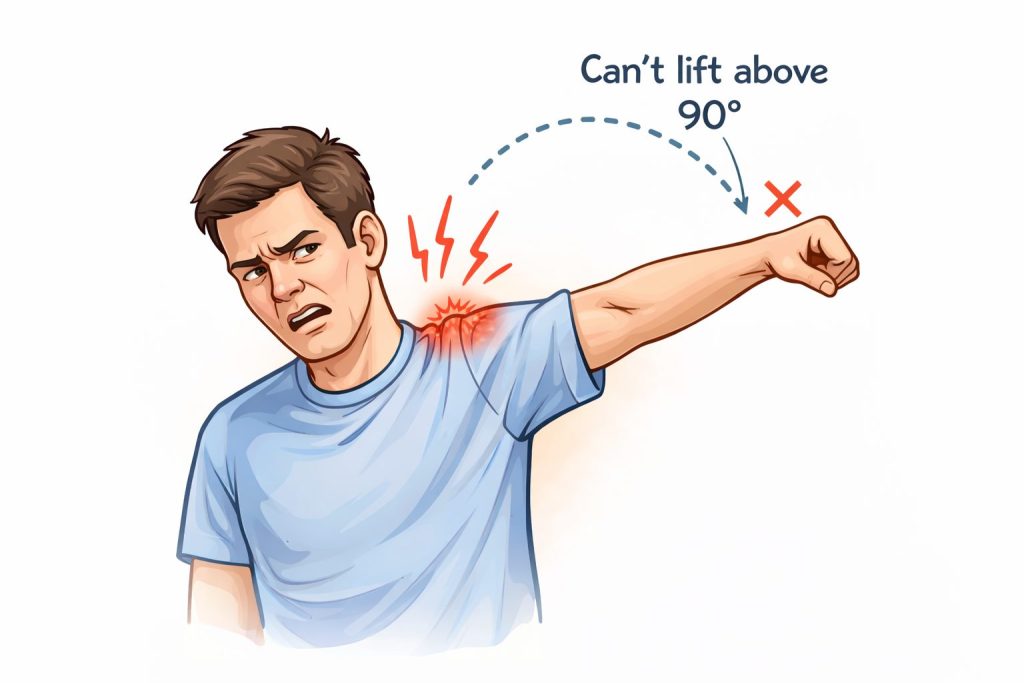
Sometimes Arm Pain Is Really a Shoulder Problem
Shoulder problems routinely cause pain farther down the upper arm.
Patients will often point halfway down the outside of their arm and tell us, “This is where it hurts.” When we examine them, the actual problem is coming from the shoulder.
Rotator cuff tendinopathy, bursitis, shoulder impingement, calcific tendinopathy and other shoulder conditions can all create pain with reaching, lifting, working overhead or sleeping on the affected side.
If the shoulder is driving the arm pain, that is what we treat.
Wrist and Hand Problems Can Cause Forearm Pain
The wrist and hand can also send symptoms farther up the forearm.
Repetitive gripping, twisting and lifting can irritate wrist tendons and place a lot of stress through the muscles that originate higher in the forearm.
Common problems include Carpal Tunnel Syndrome, TFCC tears and ulnar-sided wrist pain and thumb and De Quervain’s pain.
We look at exactly where the pain occurs, which movements reproduce it, whether there is weakness or neurological involvement, and how the problem started. That usually gives us a much clearer picture than simply calling everything “forearm strain.”
How We Treat Arm and Forearm Pain in Oakville
Once we know what is causing the symptoms, we treat the problem directly.
Our chiropractic and physiotherapy treatments commonly include hands-on soft tissue therapy, joint treatment, rehabilitation exercises, suction-based Interferential Current Therapy, moist heat, instrument-assisted soft tissue treatment and shockwave therapy.
We do not throw every treatment at every arm. A stubborn elbow tendon problem requires a completely different approach from a nerve problem coming out of the neck.
That is why the examination comes first.
Meet Our Team






IFC and Moist Heat
We commonly use suction-based Interferential Current Therapy with moist heat before hands-on treatment for painful arm and forearm conditions.
IFC is an excellent way to reduce pain and muscle guarding before we begin working on the irritated tissues. It also gives the patient a chance to relax the arm rather than starting hands-on treatment when everything is already tight and uncomfortable.
This is a standard part of how we treat many musculoskeletal problems in our clinic.

Hands-On Arm and Forearm Treatment
The forearm contains a large number of muscles responsible for gripping, moving the wrist and fingers, and controlling the elbow.
When those muscles become overloaded, painful or guarded, we work directly on them.
Depending on the diagnosis, our chiropractors and physiotherapy team use trigger-point therapy, soft-tissue release, movement-based techniques, joint mobilization and instrument-assisted soft tissue treatment.
If the problem is coming from the shoulder or neck, we treat those areas too. There is no benefit in repeatedly working on the forearm when the real source of the pain is somewhere else.
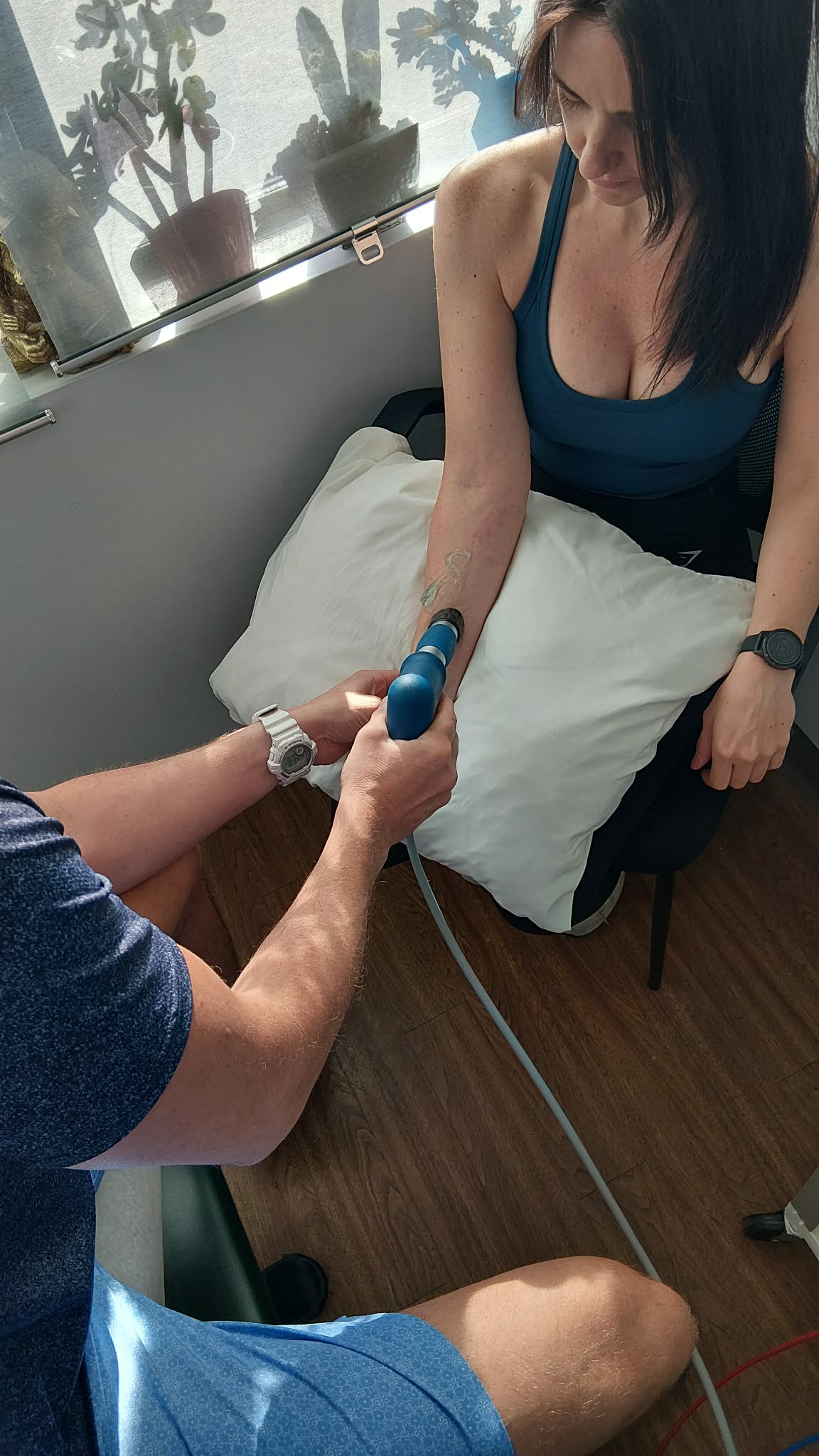
Shockwave Therapy for Arm and Forearm Tendon Pain
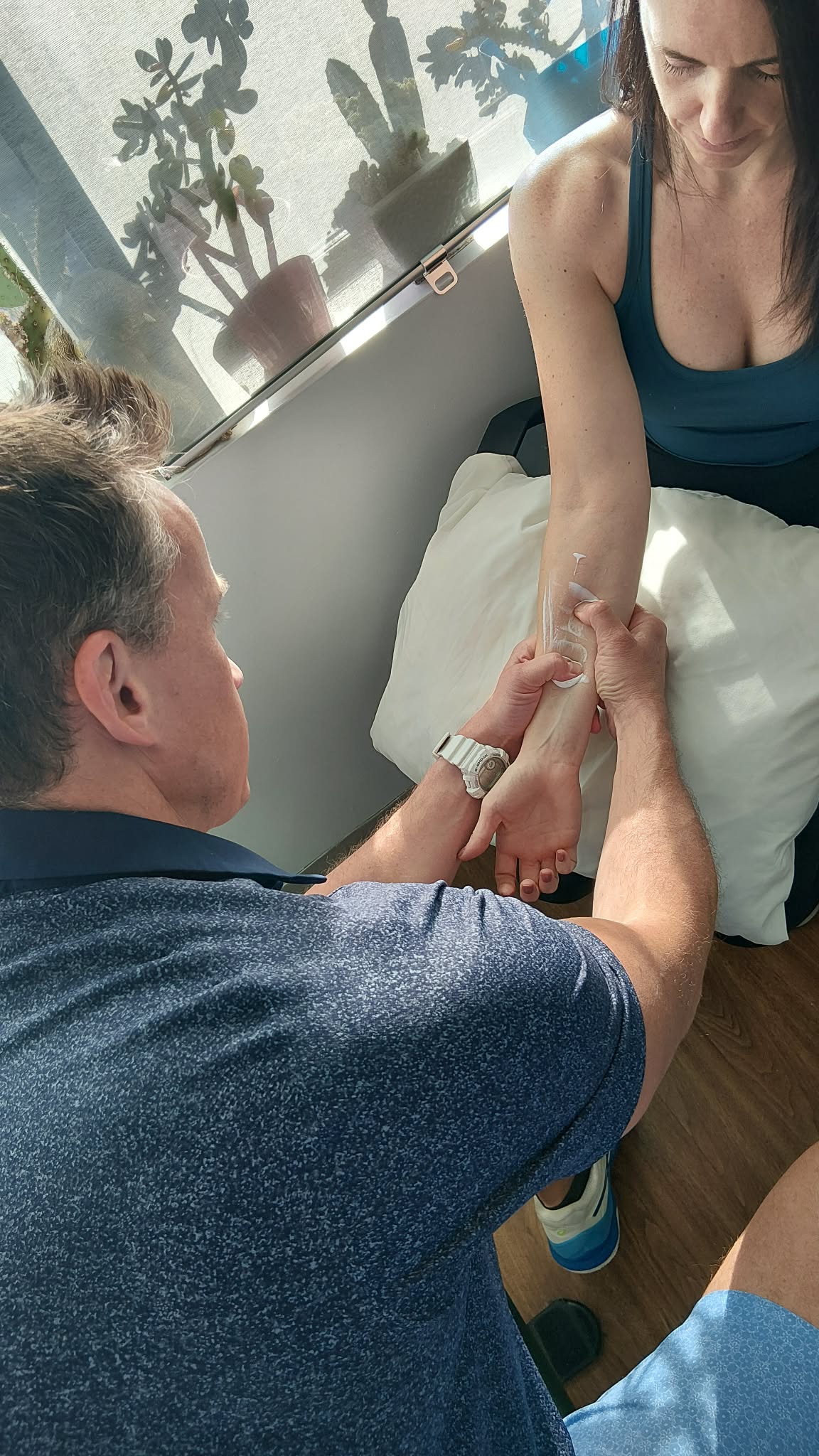
Shockwave therapy is one of our main treatments for stubborn tendon problems around the elbow and forearm.
We use radial shockwave regularly for conditions such as tennis elbow and golfer’s elbow, especially when the tendon has remained painful despite rest, stretching or other conservative treatment.
Shockwave allows us to treat the painful tendon directly. It is then combined with hands-on treatment and progressive strengthening rather than being used as a stand-alone treatment.
We have used radial shockwave therapy at Nottinghill Family Wellness Centre for more than a decade. When we use shockwave as part of a regular chiropractic or physiotherapy appointment, there is no separate shockwave fee.
Exercise and Rehabilitation
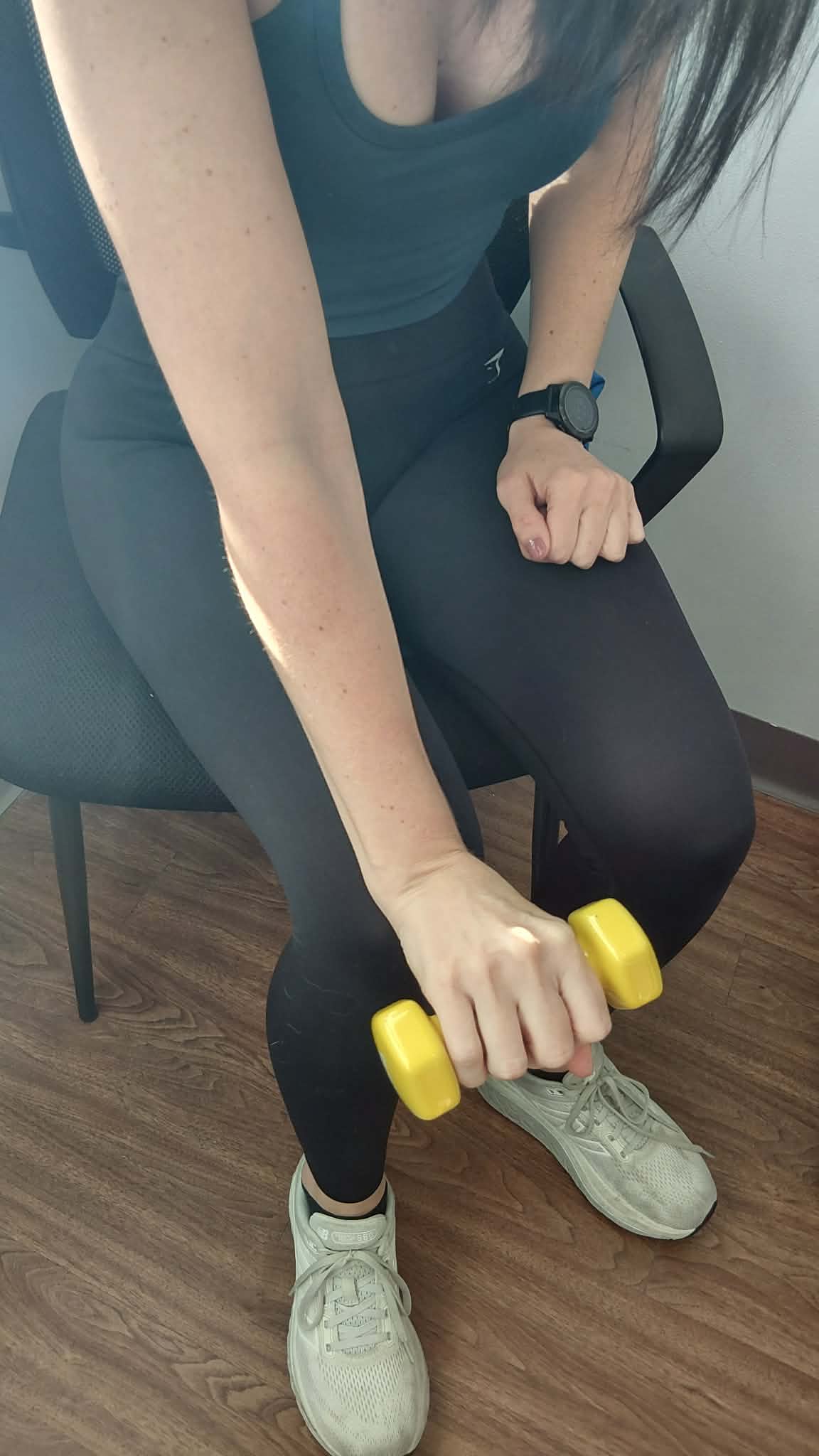
Once the pain is settling down, we start building the area back up.
For tendon problems, strengthening is extremely important. Resting a painful tendon forever usually does not solve the problem if the tendon cannot tolerate normal loading when you return to work, the gym or sport.
Rehabilitation may include wrist strengthening, forearm loading, grip work, elbow exercises, shoulder strengthening or neck exercises depending on the diagnosis.
The goal is simple: get the arm strong enough to do what you need it to do again without constantly flaring up.
What Does the Research Say About Arm and Forearm Pain?
There is no single research paper that applies to every painful arm because arm pain is a symptom, not a diagnosis. The research becomes much more useful once we know whether the problem is coming from a tendon, nerve, joint, muscle, neck or wrist.
For persistent tennis elbow and other lateral elbow tendon problems, progressive exercise and rehabilitation remain an important part of conservative treatment. A 2024 systematic review and network meta-analysis found a benefit for physiotherapy and exercise in the mid-term for lateral elbow tendinopathy. Read the lateral elbow treatment research on PubMed.
Shockwave therapy has also been studied extensively for persistent tennis elbow. The research is not completely uniform, but a recent systematic review and network meta-analysis found that medium-intensity radial shockwave performed particularly well for pain improvement among the shockwave protocols that were compared. Read the radial shockwave research on PubMed.
For patients with numbness or tingling, diagnosis becomes even more important. Cervical radiculopathy can produce pain, numbness, tingling or weakness that travels from the neck into the arm and hand. Read more about cervical radiculopathy from Cleveland Clinic.
Carpal tunnel syndrome is different. It involves compression of the median nerve at the wrist and commonly produces numbness or tingling involving the thumb, index and middle fingers. Read the American Academy of Orthopaedic Surgeons information on Carpal Tunnel Syndrome.
The important point is not that every patient needs more treatment. The important point is getting the diagnosis right first.
Chiropractic or Physiotherapy for Arm Pain?
Both our chiropractic and physiotherapy teams regularly treat arm and forearm problems.
Arm pain associated with neck movement, spinal joints or nerve irritation is commonly assessed by our chiropractors. Tendon injuries, repetitive strain, muscle problems and rehabilitation are also commonly treated by our physiotherapy team.
There is a lot of overlap between the two.
If you are not sure who you should see, call the clinic. Our front desk deals with these questions every day and can help put you with the right provider.

When Arm Pain Needs Medical Attention
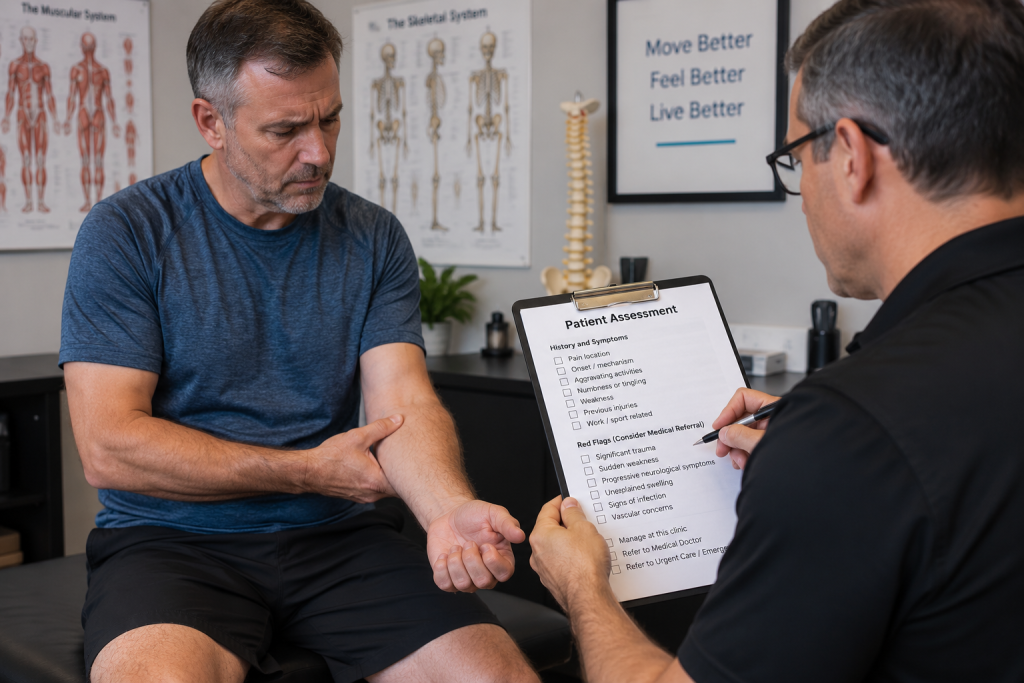
Most arm and forearm problems we see are musculoskeletal, but there are symptoms that should not wait for a chiropractic or physiotherapy appointment.
Seek urgent medical attention for sudden arm weakness or numbness, facial drooping, difficulty speaking, significant chest pain or shortness of breath, major trauma with an obvious deformity, or an arm that suddenly becomes severely swollen, pale, blue or cold.
If we assess you and believe imaging, medical investigation or another provider is required, we will tell you. We would rather send somebody for the appropriate investigation than keep treating something that clearly requires a different type of care.
Arm and Forearm Pain FAQ
Why does my forearm hurt when I grip or lift something?
Pain with gripping and lifting commonly comes from the muscles and tendons around the elbow and forearm. Tennis elbow is particularly common on the outside of the elbow, while golfer’s elbow affects the inside.
There are other possibilities, which is why we look at the exact location of the pain and which movements reproduce it.
Learn more about Tennis Elbow Treatment in Oakville
Can a problem in my neck cause arm and forearm pain?
Absolutely.
A cervical nerve can become irritated in the neck and produce pain, burning, numbness, tingling or weakness farther down the arm. Some patients have very little neck pain even though the source of their arm symptoms is coming from the cervical spine.
Learn more about Neck Pain Treatment in Oakville
Why is my arm tingling or going numb?
Tingling tells us that a nerve needs to be considered.
The location of the symptoms helps us narrow things down. Symptoms can originate from a nerve in the neck, Thoracic Outlet Syndrome, nerve irritation around the elbow or Carpal Tunnel Syndrome at the wrist.
The answer is not to simply massage whichever part of the arm happens to be tingling. We need to figure out which nerve is involved and where it is being irritated.
How can I tell tennis elbow from golfer’s elbow?
The easiest starting point is the location.
Tennis elbow usually causes pain around the outside of the elbow and upper forearm. Golfer’s elbow usually hurts on the inside.
Both can become painful with gripping, lifting, gym exercises, work and sports. An examination can usually separate the two fairly quickly.
Learn more about Tennis Elbow or Golfer’s Elbow.
Can shoulder problems cause pain halfway down my arm?
Very commonly.
Rotator cuff and other shoulder problems frequently produce pain down the outside of the upper arm. Patients often point to the arm as the painful area even though examination shows that the shoulder is producing the symptoms.
Learn more about Shoulder Pain Treatment in Oakville.
Do you use shockwave therapy for forearm and elbow pain?
Yes. We use radial shockwave therapy regularly for persistent tendon problems around the elbow and forearm, particularly tennis elbow and golfer’s elbow.
We combine shockwave with the other treatment the patient needs rather than treating it as a magic machine. Hands-on treatment and progressive strengthening are usually important parts of getting a stubborn tendon functioning properly again.
When shockwave is used during a regular chiropractic or physiotherapy appointment at our clinic, there is no additional shockwave fee.
Learn more about Shockwave Therapy in Oakville.
Should I rest forearm pain or keep exercising?
It depends on what is injured.
If gripping and lifting are constantly aggravating an irritated tendon, temporarily reducing that load makes sense. But completely resting a tendon for weeks and then immediately returning to the same activity often leaves you right back where you started.
For most tendon problems, we progressively rebuild strength as symptoms allow. The amount and type of exercise should match the diagnosis and how irritated the tissue is.
Should I see a chiropractor or physiotherapist for arm pain?
Either can be appropriate at our clinic.
Our chiropractors commonly assess arm symptoms associated with the neck, nerve irritation, joints and musculoskeletal injuries. Our physiotherapy team also treats elbow and forearm tendon problems, muscle injuries, repetitive strain and rehabilitation.
There is a lot of overlap. If you call and describe the problem, our front desk can help direct you.
Learn more about Chiropractic Treatment or Physiotherapy in Oakville.
When should I be concerned about arm pain?
Arm pain after repetitive use, exercise or a minor injury is very different from sudden neurological or vascular symptoms.
Seek urgent medical attention for sudden significant arm weakness or numbness, facial drooping, difficulty speaking, chest pain or shortness of breath, severe trauma with deformity, or an arm that suddenly becomes very swollen, cold, pale or blue.
If something does not look like a routine musculoskeletal problem during our assessment, we refer it for the appropriate medical investigation.
Book Arm and Forearm Pain Treatment in Oakville
If your arm hurts every time you grip, lift, type, exercise or use your hand — or you have numbness and tingling and cannot figure out where it is coming from — come in and let us take a look.
We treat arm and forearm pain every week at Nottinghill Family Wellness Centre. The first job is figuring out what is actually causing it. Then we can build the treatment around the problem instead of guessing.
Nottinghill Family Wellness Centre
1131 Nottinghill Gate
Oakville, Ontario L6M 1K5
Call: 905-827-4197
Text: 289-228-8858
Content Reviewed By: Dr. Steve Knighton, B.Sc., D.C. on October 12, 2026
Chiropractic License Number: 5580