Content Reviewed By: Dr. Steve Knighton, B.Sc., D.C. on October 12, 2026
Chiropractic License Number: 5580
Low Back Pain Treatment & Relief in Oakville
Low back pain is one of the most common reasons patients visit our Oakville chiropractic and physiotherapy clinic. It may begin suddenly after lifting, exercise, a fall or car accident, or gradually from prolonged sitting, repetitive activity, reduced mobility or age-related changes.
Low back pain is one of the most common problems treated by our Oakville chiropractic team, and treatment starts with identifying whether the pain is coming primarily from the joints, discs, muscles, nerves or a combination of them.
At Nottinghill Family Wellness Centre, our chiropractors and physiotherapists start by figuring out what is most likely driving your low back pain. We assess the joints, discs, nerves, muscles, sacroiliac joints and the way you are moving so we can treat the actual problem rather than simply treating the words “low back pain.”
Once we know what we are dealing with, treatment is built around those findings. Care can include chiropractic adjustments or mobilization, physiotherapy, hands-on soft tissue treatment, targeted exercise, suction IFC and shockwave therapy when the surrounding muscles and soft tissues are involved.
Low back pain is the leading cause of disability worldwide, but most episodes are not caused by a dangerous medical condition. A proper assessment can help determine whether your symptoms are mechanical or whether further medical investigation is required.
Low Back Pain Anatomy: What Can Actually Cause the Pain?
Low Back Pain: Quick Answers
What causes low back pain?
Low back pain can arise from muscles, joints, discs, ligaments, the sacroiliac joints or irritation of nerves in the lumbar spine. In many patients, more than one structure contributes to the symptoms.
When should I see someone for low back pain?
Consider an assessment if the pain is severe, keeps returning, limits normal activity, travels into the leg, or is not improving as expected.
Do I need an X-ray or MRI?
Most uncomplicated episodes of low back pain do not require immediate imaging. Imaging may be appropriate when there has been significant trauma, progressive neurological symptoms, suspicion of fracture or another serious condition, or when the result would change treatment.
Can chiropractic care help low back pain?
Yes. For many patients with mechanical low back pain, chiropractic treatment can help reduce pain and improve function. We use spinal manipulation or mobilization based on what we find during the examination and combine hands-on treatment with exercise, movement and other appropriate therapies rather than relying on an adjustment alone.
Can physiotherapy help low back pain?
Yes. Physiotherapy may include mobility work, manual therapy, progressive strengthening, core stabilization and a home exercise program based on the patient’s presentation.
Do I have Sciatica?
Sciatica commonly causes pain, burning, tingling or numbness that travels from the lower back into the buttock and leg. Unlike localized back pain, it may involve irritation of a lumbar nerve root.Learn more about our sciatica treatment in Oakville.
The lower back is made up of five lumbar vertebrae along with discs, facet joints, ligaments, muscles and nerves. The pelvis and sacroiliac joints also interact closely with the lumbar spine, while muscles such as the quadratus lumborum, multifidus, gluteals, piriformis and hip flexors can influence movement and loading through the region.
Low back pain does not always come from one specific structure. Pain may be associated with irritated spinal joints, muscle or ligament strain, disc-related pain, sacroiliac joint dysfunction, nerve irritation or a combination of these factors.
Pain travelling into the buttock or leg can sometimes indicate irritation of a lumbar nerve root or sciatic nerve. Other patients experience localized low back pain without neurological symptoms. This is why assessment is important rather than assuming every episode has the same cause.
Our Oakville chiropractors and physiotherapists examine range of motion, strength, neurological function, posture, movement patterns and the surrounding muscles and joints to help determine the most appropriate treatment approach.
Common Causes Of Low Back Pain
- Mechanical or non-specific low back pain – pain involving the joints, muscles and surrounding tissues without one clearly identifiable damaged structure.
- SI joint-related pain – pain around the back of the pelvis that may be aggravated by standing, walking, rolling in bed or changing positions.
- Muscle strain or spasm – commonly involving the quadratus lumborum, multifidus, gluteal muscles or other tissues surrounding the lumbar spine.
- Lumbar disc irritation or herniation – may cause localized back pain or symptoms travelling into the leg.
- Sciatica or lumbar nerve irritation – pain, tingling, numbness or other neurological symptoms that can travel from the lower back into the leg.
- Lumbar spinal stenosis – narrowing around spinal nerves that may cause back or leg symptoms, particularly during standing and walking.
- Facet joint irritation – pain arising from the small joints at the back of the lumbar spine.
- Reduced strength or physical conditioning – inadequate trunk, hip and lower-extremity strength may contribute to recurring symptoms in some patients.
- Low back pain is also common during pregnancy as posture, weight distribution and the demands on the lumbar spine and pelvis change. We have a separate guide to low back pain and chiropractic care during pregnancy.
- Pain felt at the beltline or top of the pelvis can involve the lumbar spine, surrounding muscles, SI region or the transition between the lower thoracic and upper lumbar spine. That transition is called the thoracolumbar junction. Our guide explains how TL junction pain can overlap with low-back and pelvic pain
How We Treat Low Back Pain in Oakville
Low back pain is not one-size-fits-all, and neither is our treatment. We start by determining what is actually irritated, what movements are reproducing the pain and whether the problem is primarily coming from the lumbar joints, surrounding muscles, the SI joint, a disc, nerve irritation or a combination of several things.
From there, we treat what we find. Our Oakville chiropractic and physiotherapy team combines hands-on care with exercise and rehabilitation, and we regularly use treatments such as spinal manipulation or mobilization, soft tissue therapy, suction IFC and shockwave therapy when they fit the problem.
Doctor Steve Knighton has been treating low back pain in Oakville for nearly 20 years, while our physiotherapy team is led by Vinaya, who brings more than 26 years of clinical experience. Between the two sides of the clinic, we have a lot of experience figuring out stubborn backs.

5 Steps for Treating Low Back Pain In Oakville
Step 1: Suction IFC and Heat
Suction IFC is a regular part of how we treat low back pain at our Oakville clinic. Instead of adhesive pads, we use vacuum suction cups across the muscles surrounding the lower back and combine the IFC with moist heat.
For most of our low back pain patients, this is where the appointment starts. The goal is to reduce pain, relax tight or guarded muscles and get the area ready before we move into the more hands-on part of treatment. Patients generally love this part — think of it as the appetizer before the actual meal.

Step 2: Shockwave Therapy for Low Back Pain
When tight, painful or chronically irritated muscles are contributing to the problem, we use shockwave therapy to work directly on the surrounding soft tissues. With low back pain, common treatment areas include the quadratus lumborum, gluteal muscles and other tight or tender tissues identified during the examination.
We are not firing shockwave directly into the lumbar spine or trying to “fix a disc” with it. We use it on the muscles and soft tissues surrounding the back when those tissues are clearly part of the problem.
Research on shockwave for chronic low back pain has shown promising results for pain and function. We use it as one part of a complete treatment approach — not as some miracle machine that magically cures every bad back. The location, intensity and number of pulses are adjusted to the patient and the area we are treating.

Step 3: Soft Tissue Therapy and Trigger Point Treatment
Low back pain often comes with a lot of muscle guarding. The quadratus lumborum, lumbar paraspinals, multifidus, gluteal muscles, piriformis and hip flexors can all become tight, painful or restricted when your back is irritated.
When we find those areas during the examination, we treat them. That can include hands-on muscle release, trigger point therapy and movement-based soft tissue techniques. We do not automatically attack the same muscle on every patient — the treatment is based on what is actually tight, tender or restricted in front of us.

Step 4: Chiropractic Spinal Manipulation or Mobilization
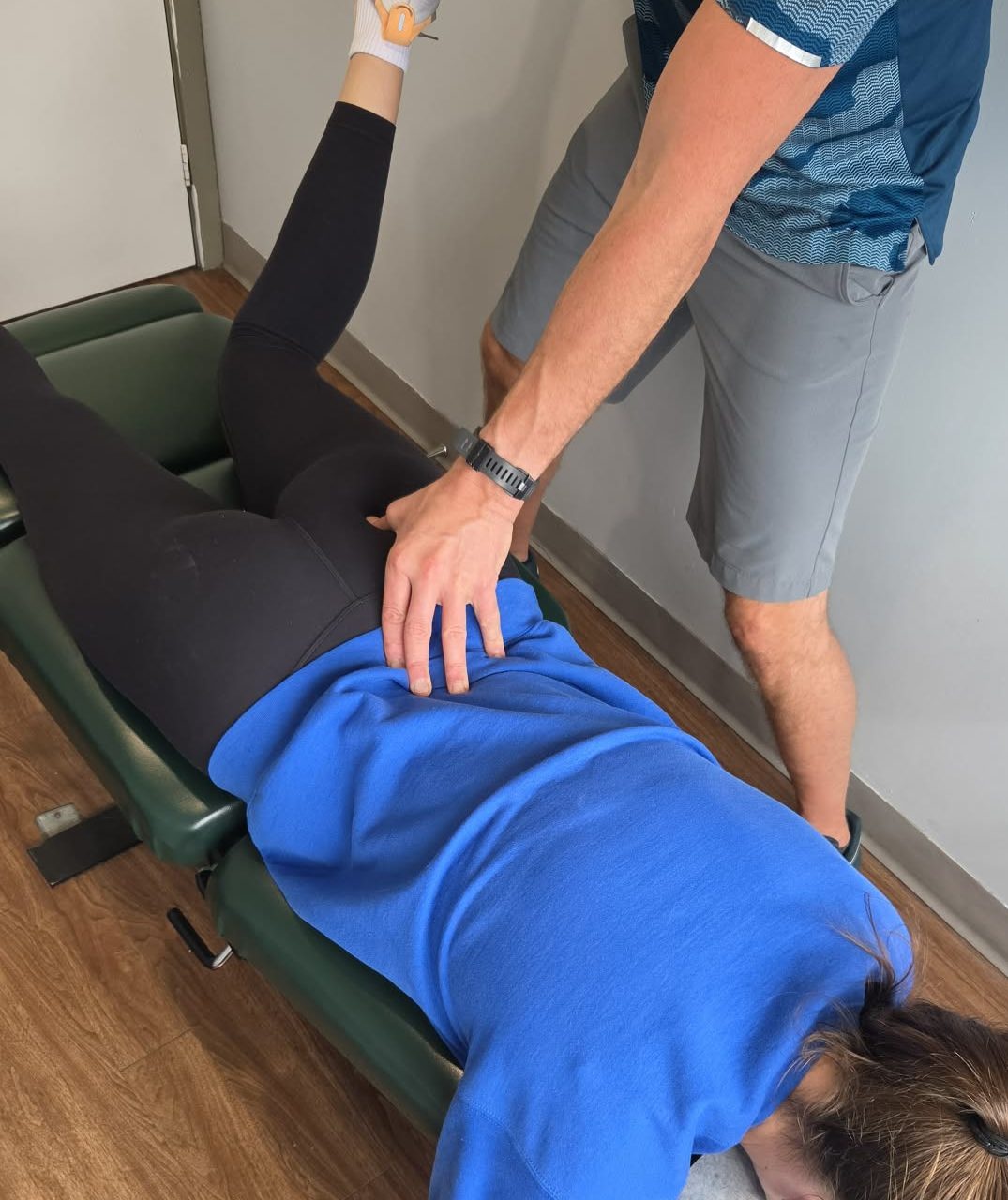
Chiropractic spinal manipulation and mobilization are two of the main hands-on treatments we use for mechanical low back pain. When the examination shows restricted or painful spinal movement, these techniques can help reduce pain, improve mobility and get the back moving more normally again.
The adjustment itself is always matched to the patient. Age, health history, diagnosis, comfort level and examination findings all matter. Some patients respond well to a traditional chiropractic adjustment, while others are better suited to a lower-force technique or mobilization.
Doctor Steve Knighton has been providing chiropractic care in Oakville for nearly 20 years, and the goal has never been to give every patient the exact same adjustment. We treat what we find, reassess how you are responding and combine the hands-on treatment with movement and exercise so you keep progressing.

Step 5: Exercise, Core Stability and Preventing Recurrence
As pain settles, treatment increasingly focuses on restoring normal movement, strength and confidence. Exercise is one of the most important components of long-term low back pain management.
Depending on the patient’s needs, rehabilitation may include core stabilization, hip and glute strengthening, mobility exercises and gradual return to work, sport or normal daily activity.
Our chiropractors and physiotherapists can modify exercises according to the severity of your symptoms. Someone experiencing significant acute pain will usually begin differently than an experienced gym-goer recovering from a recurring back problem.

What Our Patients Are saying About Low Back Pain
-
Dr. Steve comes highly recommended. He has helped me recover from multiple injuries, and the improvement has been remarkable. My daughter is also a patient, and she’s experienced the same positive results. The entire staff is friendly, welcoming, and truly cares about their patients. We’re grateful to have found such... read more

 Yvette
March 18, 2026Steve is a “fountain” of information and goes the extra mile to make you feel comfortable throughout the treatment
Kimberley Toppin
May 22, 2026The entire office staff is welcoming and kind, and everything is always quick and efficient. Dr. Steve is very friendly and knowledgeable. He was able to pinpoint my issue right away and explain everything clearly. I felt immensely better after just my first appointment. I would highly recommend Nottinghill Family... read more
Lisa
August 6, 2026 -
I was initially reluctant to try another chiropractor after a series of bad experiences that left me in more pain. However, my husband visited Dr. Steve at Nottinghill Family Wellness Centre following a scary knee injury and had nothing but amazing things to say about his care. He booked me... read more
Ingy ES
September 7, 2024Love Dr. Steve's sense of humour, enthusiasm and determination to make you feel better he always adds a positive part in our day when we come here thank you! We love the staff at the front desk and the helpers of Dr Steve they are so kind and hardworking. Thank... read more
gunes ozok
December 7, 2024Amazing people and treatment here! My back was killing me and within 3 weeks they got me fixed to 100%!
Blaze Slavkovski
July 7, 2024 -
Where does one even begin?? I can’t say enough good things about Dr. Steve and his amazing team! I went in with unbearable SI joint pain—pain so intense that it was affecting my daily life. From the moment I walked into their office, I felt welcomed, cared for, and... read more
Krystal Milwain
March 5, 2025Dr.Steve and his team are very professional, focused. I came with severe pain in my knee, and he quickly got to the point, and in three sessions, I have recovered considerably- from not being able to walk and pain to a level of 10/10 in some positions, to being able... read more
Prashant Bhatt
November 7, 2024Dr Steve is a very cool dude
Spencer Parkins
May 20, 2026


What Causes Low Back Pain?

Low back pain can begin in many different ways. Some patients remember one specific movement such as lifting, twisting or playing a sport. Others develop symptoms gradually after prolonged sitting, repetitive work or changes in physical activity.
Risk factors can include reduced physical conditioning, repetitive lifting, prolonged sitting, previous episodes of low back pain, certain occupational demands and age-related changes. However, back pain is rarely explained by posture or one weak muscle alone.
Remaining active within your tolerance is generally preferable to prolonged bed rest. As symptoms improve, progressive exercise can help restore strength, mobility and confidence.
Low Back Pain Videos From Our Oakville Chiropractic Team
The videos below explain some of the muscles, joints and conditions that may contribute to low back pain. They are educational resources and do not replace an individual examination or diagnosis.
Oakville Treatment for SI joint Low Back Pain
SI Joint & Low Back Pain Relief:
The sacroiliac joints connect the pelvis to the sacrum and can be one source of pain around the lower back, buttock and posterior pelvis. SI joint-related pain can sometimes feel similar to pain originating from the lumbar spine, hip or surrounding muscles.
Patients may notice discomfort when changing positions, rolling in bed, walking, climbing stairs or moving from sitting to standing. Because several conditions can create similar symptoms, an examination is important before attributing low back pain specifically to the SI joint.
Quadratus Lumborum Anatomy and Its Role in Lower Back Pain
Quadratus Lumborum Treatment Video:
Treatment for Psoas and Hip Flexor for Back Pain!
IT Band and Low Back Pain Treatment Video:
Chiropractic Adjustments for Low Back Pain in Oakville
Chiropractic adjustments are one of the treatments we regularly use for mechanical low back pain, but we do not automatically adjust every back simply because somebody walks through the door saying it hurts. First, we determine what is causing the pain and whether spinal manipulation or mobilization makes sense for that patient.
When an adjustment is indicated, the chiropractor applies a controlled movement or quick thrust to the appropriate spinal joint. Some adjustments create the familiar popping sound and others do not. The sound is not what makes the treatment successful.
At Nottinghill Family Wellness Centre, chiropractic treatment is rarely just an adjustment. We combine it with the other parts of care that make sense for the problem — including soft tissue treatment, suction IFC, exercise, rehabilitation and shockwave therapy when needed.

Acupuncture for Low Back Pain Oakville
Acupuncture is another treatment option available at Nottinghill Family Wellness Centre. Dr. Jenn may incorporate acupuncture when appropriate based on the patient’s symptoms, preferences and clinical presentation.
Acupuncture involves inserting very fine needles into selected points and may be used as part of a broader plan for pain management and muscular relaxation. It is not required for every patient with low back pain.
Low Back Pain FAQs
What causes low back pain?
Low back pain can arise from muscles, joints, discs, ligaments or nerves. Common presentations include mechanical low back pain, muscle strain, SI joint-related pain, disc irritation, sciatica and age-related degenerative changes. In many patients there is no single structure responsible for every symptom.
How do I know if I have sciatica?
Sciatica commonly describes pain associated with irritation of the sciatic nerve or lumbar nerve roots. Symptoms may travel from the lower back or buttock into the thigh, calf or foot and can include burning, tingling, numbness or weakness. Leg pain does not automatically mean sciatica, so an examination can help determine the cause.
Is sciatica an emergency?
Most cases of sciatica are not medical emergencies. Urgent medical assessment is required when back or leg symptoms are accompanied by new loss of bowel or bladder control, numbness around the groin or saddle region, or severe or rapidly progressing leg weakness.
What treatment is best for low back pain?
There is no single treatment that is best for every patient. Treatment depends on the cause, duration and severity of the symptoms. Evidence-informed care commonly includes education, remaining active, appropriate exercise and, for selected patients, manual therapy such as spinal manipulation, mobilization or soft tissue therapy.
Do I need an X-ray or MRI for low back pain?
Most patients with uncomplicated low back pain do not require immediate imaging. Imaging may be appropriate following significant trauma, with certain neurological findings, when a serious underlying condition is suspected, or when the result is likely to change treatment.
Should I use ice or heat for low back pain?
Either may provide temporary symptom relief. Some patients prefer ice following an acute flare-up, while others find heat more comfortable for muscle stiffness. Use whichever is comfortable and avoid extreme temperatures or prolonged direct skin exposure.
Should I stay in bed when my back hurts?
Prolonged bed rest is generally not recommended for uncomplicated low back pain. Remaining reasonably active and gradually returning to normal activity is usually encouraged, provided serious injury or neurological problems have been ruled out.
Should I see a chiropractor or physiotherapist for low back pain?
Both chiropractors and physiotherapists commonly assess and manage mechanical low back pain. The most appropriate provider depends on your symptoms, treatment preferences and individual needs. Our Oakville clinic offers both services, allowing care to be coordinated when appropriate.
Can exercises help low back pain?
Yes. Exercise is an important component of managing and preventing many types of recurring low back pain. Programs may include trunk stabilization, hip strengthening, mobility exercises and gradual return to normal activity.
Can low back pain come from a herniated disc?
Yes. Lumbar discs can contribute to localized back pain and may irritate nearby nerve roots, sometimes causing pain, numbness or tingling into the leg. However, disc changes are also commonly found on imaging in people who have no pain, so imaging findings must be interpreted together with the patient’s symptoms and examination.
Can low back pain come from the SI joint?
Yes. The sacroiliac joint can be one potential source of pain around the lower back, buttock and pelvis. Because SI joint pain may resemble lumbar spine, hip or muscular pain, diagnosis should be based on the complete clinical examination.
How long does low back pain take to improve?
Recovery varies considerably depending on the diagnosis, severity, previous episodes, activity level and other individual factors. Many uncomplicated episodes improve over time, while persistent or recurring pain may require a longer rehabilitation approach.
Exercises for Low Back Pain
If your back tightens during hockey, golf or lifting, tell us when it starts and which movements aggravate it. Dr. Steve and Dr. Alex provide sports chiropractic assessment in Oakville with treatment and exercise recommendations built around your findings and activity goals.
Exercise is an important part of managing many types of low back pain and reducing the likelihood of recurring problems. There is no single perfect back exercise for everyone, so the program should match the person’s symptoms, ability and stage of recovery.
Common exercises may include:
- Bird dog
- Dead bug
- Side plank
- Modified curl-up
- Glute bridge
- Pallof press
- Hip and glute strengthening
- Individualized mobility exercises
During an acute episode, exercises may need to be modified. Stop an exercise and seek professional advice if it causes significant worsening of pain, new numbness or tingling, progressive weakness or other unusual neurological symptoms.
Exercises can be modified for almost every stage of low back pain. Patients with significant acute symptoms may begin with gentle movements and basic stabilization, while those further along in recovery can progress toward more challenging strength and conditioning exercises.
Read enough and ready to start treatment in Oakville for that annoying lower back pain?
Low Back Pain Red Flags: When to Seek Urgent Medical Attention
Most low back pain is not caused by a dangerous condition. However, certain symptoms require urgent medical assessment.
Seek urgent medical attention for low back pain accompanied by:
- New loss of bladder or bowel control
- Difficulty controlling or initiating urination
- New numbness around the groin, genitals or inner thighs
- Severe or rapidly progressive weakness in one or both legs
- Significant difficulty walking or loss of coordination
- Severe pain following substantial trauma
- Back pain accompanied by fever or significant systemic illness
- Persistent unexplained pain associated with a history of cancer or unexplained weight loss
These symptoms do not necessarily mean that a serious condition is present, but they warrant prompt medical evaluation.
Ready to Have Your Low Back Pain Assessed?
If low back pain is interfering with your work, sleep, gym, golf, running or even just getting through the day comfortably, come in and let us take a look at it. Our Oakville chiropractic and physiotherapy team will figure out what is most likely causing the problem, explain what we find and get started on the appropriate treatment.
Nottinghill Family Wellness Centre
1131 Nottinghill Gate, Oakville, Ontario
Call: 905-827-4197
Text: 289-228-8858
Content Reviewed By: Dr. Steve Knighton, B.Sc., D.C. on October 12, 2026
Chiropractic License Number: 5580