Pain at the top of the low back can be hard to pin down. Some people feel it beside the spine. Others notice pain along the top of the pelvis, around the hip or into the glute. The spot that hurts is not always the place the problem starts.
At Nottinghill Family Wellness Centre in Oakville, Doctor Steve and Doctor Alex assess the thoracolumbar junction, lumbar spine, quadratus lumborum, surrounding muscles and SI region to determine what is contributing to the pain. Treatment is based on the examination, not just the location you point to.
How We Treat Thoracolumbar Junction Pain in Oakville
Treatment depends on what the assessment finds. Pain in this area can involve the thoracolumbar junction, lumbar joints, quadratus lumborum, multifidus, gluteal muscles, SI region or more than one of these structures.
[Image: Doctor Steve assessing the lower thoracic and upper lumbar area]
Suction IFC and Heat

Many appointments begin with suction Interferential Current Therapy (IFC) and moist heat across the muscles around the lower thoracic and lumbar spine. The aim is to help settle pain and muscle guarding before hands-on treatment.
Shockwave for Selected Muscle Trigger Points

When the assessment finds a distinct, tender area in the quadratus lumborum, multifidus or nearby gluteal muscles, Shockwave Therapy may be used on the involved soft tissue. The treatment area and settings depend on the examination. Shockwave is not automatically used on every case of back pain.
ART and Instrument-Assisted Soft Tissue Treatment
Active Release Technique (ART) and instrument-assisted soft tissue treatment can be used on muscles and soft tissues that are tender or restricted. Depending on the findings, treatment may include the QL, multifidus, lumbar muscles or surrounding hip and gluteal muscles.
Chiropractic Adjustments
When appropriate, Doctor Steve or Doctor Alex may use manual adjustments or mobilization for the lower thoracic spine, thoracolumbar junction, lumbar spine or SI region. The examination guides which area is treated. An adjustment is not automatically applied to every painful spot.
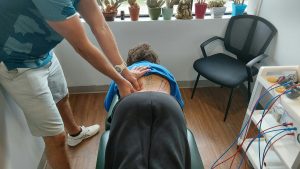
Picture 1 shows a typical low back or SI joint adjustment. Dr. Steve places his lower hand at the patient’s gluteal area and applies pressure through the upper shoulder to create movement in the lower back.
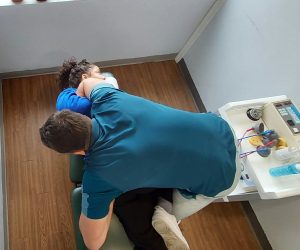
For the TL junction adjustment in Picture 2, Dr. Steve changes his lower hand contact to the TL region and positions his upper forearm against the patient’s armpit. During the adjustment, he applies pressure through the arm to create a distracting force at the TL junction. This directs the adjustment toward the lower thoracic spine rather than the lumbar spine, as in a typical low back adjustment.

Exercise, Physiotherapy and Acupuncture
Some patients benefit from movement guidance and exercises to rebuild comfortable movement and support a return to work, lifting or sport. Our physiotherapy team can provide assessment and rehabilitation when that fits the patient’s needs.
Acupuncture with Dr. Jenn is another option for selected patients. It can be included in a broader plan when appropriate and is not required for everyone.
What Is the Thoracolumbar Junction?
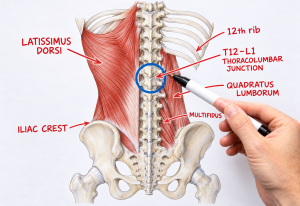
The thoracolumbar junction is the transition between the lower thoracic spine and the upper lumbar spine. It is around the level where the lower ribs meet the low back. The exact spinal levels considered part of the junction can vary, but T12–L1 is commonly used to describe the transition.
The quadratus lumborum and multifidus are among the muscles near this area. The QL connects the pelvis, lumbar spine and lowest rib. The multifidus muscles run along the spine and help control movement between spinal segments.
When people search for TL junction pain, they may mean pain directly around this transition. In some cases, pain can also be felt away from the junction, including around the top of the pelvis, hip or glute. A pain pattern sometimes called Maigne syndrome is one possible explanation for referred pain from this region. It is a term for a particular clinical pattern, not a label that can be confirmed from symptoms alone. A peer-reviewed review discusses Maigne syndrome and the proposed pain pathways.
[Image: Diagram showing the lower thoracic spine, T12–L1 junction, lumbar spine and QL]
Why TL Junction Pain Can Feel Like SI, Hip or Glute Pain
The spine, pelvis and surrounding muscles work together when you bend, rotate, lift, walk or sit. Because of this, pain from one area can be felt somewhere nearby. A person may point to the top of the pelvis or the glute even when the examination also needs to check the lower thoracic and upper lumbar spine.
The SI joint, lumbar spine, QL and gluteal muscles can all be relevant to pain around the beltline or upper buttock. The right place to focus treatment depends on the history, movement testing and examination. Doctor Steve and Doctor Alex do not assume that pain near the SI joint means the SI joint is the only source.
For more detail on nearby problems, read about SI joint pain, quadratus lumborum pain and piriformis and glute pain.
[Image: Diagram showing possible pain locations around the TL junction, QL, SI region and glute]
When Lower Rib Pain Is Part of the Picture
Pain around the lower ribs or side of the trunk can have a different source from pain at the TL junction. Some people with rib-area symptoms read about back pain and assume it is all coming from the same place. The location, movement pattern and examination help distinguish these possibilities.
For another common source of confusing back or side pain, see our information on rib pain and slipping rib syndrome. Rib pain, abdominal symptoms or flank pain should not automatically be attributed to a spinal or muscle problem.
How Doctor Steve and Doctor Alex Assess TL Junction Pain
The first step is hearing how the pain started and what makes it better or worse. Doctor Steve or Doctor Alex then checks the movement of the thoracic and lumbar spine, the nearby muscles and the areas where you feel symptoms. The assessment may also include the hip, glute and SI region if those areas are part of the complaint.
The aim is to identify which findings match your symptoms and whether chiropractic care is appropriate. If the symptoms suggest that another type of assessment is needed, the next step is explained. Imaging is considered when the history and examination indicate it; it is not automatically required for every case of back pain.
TL Junction Pain in Athletes and Active People
Rotation, lifting, sprinting and repeated bending can aggravate the lower thoracic and upper lumbar region. Athletes may feel the pain around the spine, beltline, hip or glute, and the symptoms can affect training, work or ordinary daily activities.
Treatment should match the person’s sport and goals. When appropriate, care can combine hands-on treatment with progressive movement and strengthening. Learn more about sports chiropractic care with Doctor Steve and Doctor Alex or sports physiotherapy with Vinaya.
[Image: Active patient receiving assessment or rehabilitation for back pain]
Book an Oakville Assessment for Thoracolumbar Junction Pain
Nottinghill Family Wellness Centre is located in Glen Abbey, Oakville. Doctor Steve and Doctor Alex assess back pain involving the TL junction, lumbar spine, QL, glutes and SI region.
The clinic has private treatment rooms, evening appointments and Saturday hours from 7:00 a.m. to 11:30 a.m. Same-day appointments are available when scheduling permits. New patients are welcome. Chiropractic visits are $75 and physiotherapy visits are $80. Shockwave is included in the regular visit when clinically appropriate. Direct billing is available for many plans when permitted by the benefits provider.
Contact our Oakville clinic to ask about an appointment. Call 905-827-4197 or text 289-228-8858.
Thoracolumbar Junction Pain FAQs
What is the thoracolumbar junction?
The thoracolumbar junction is where the lower thoracic spine transitions into the upper lumbar spine. It is near the bottom of the rib cage and the top of the low back.
What does TL junction pain feel like?
It may feel like pain or stiffness near the lower thoracic or upper lumbar spine. Some people notice pain around the beltline, top of the pelvis, hip or glute. Symptoms alone cannot identify the exact source.
Can the thoracolumbar junction cause pain around the hip or glute?
Pain from this region can sometimes be felt away from the spine, including around the iliac crest, hip or glute. Those areas can also have other causes, so an assessment checks the back, pelvis and nearby muscles.
Is TL junction pain the same as SI joint pain?
No. The areas are close and their symptoms can overlap, but TL junction pain and SI-region pain are not the same diagnosis. The examination checks which findings best match your symptoms.
Is TL junction syndrome the same as Maigne syndrome?
Maigne syndrome is a name used for a particular referred-pain pattern associated with the thoracolumbar region. The terms are related, but pain near the TL junction does not by itself establish that diagnosis.
Can QL or multifidus muscle pain feel like TL junction pain?
Yes. The QL and multifidus muscles are near the thoracolumbar and lumbar spine, and irritation in nearby muscles can contribute to pain around the back or pelvis. The assessment helps determine whether these muscles are involved.
Can TL junction pain feel like sciatica?
Pain from the lower thoracic or upper lumbar region can sometimes be felt in the buttock or hip and may be confused with other back or leg problems. Numbness, tingling, weakness or pain travelling down the leg should be assessed rather than assumed to be referred muscle pain. See our page on sciatica treatment in Oakville.
How is thoracolumbar junction pain assessed?
The assessment starts with the history and checks spinal movement, the painful areas and nearby muscles and joints. The hip, glute and SI region may also be assessed. Imaging is considered when the findings indicate it.
What treatment can help TL junction pain?
Treatment depends on the examination. It may include suction IFC and heat, Shockwave to selected tender soft-tissue areas, ART or instrument-assisted soft tissue treatment, appropriate spinal or SI-region adjustments, and exercises. Acupuncture or physiotherapy may also be considered.
Is Shockwave used directly on the spine?
Shockwave may be used on selected soft-tissue areas, such as a tender muscle or trigger point, when appropriate. The treatment location is chosen from the examination and is not automatically applied to every painful area.
Can acupuncture be part of treatment?
Acupuncture with Dr. Jenn may be included for selected patients as part of a broader care plan. It is optional and depends on the patient’s presentation and preferences.
How many visits will I need?
That depends on how long the problem has been present, what the assessment finds and how symptoms respond. The plan and progress are reviewed as care continues. No fixed number of visits is right for everyone.
Should I keep moving if my back hurts?
In many cases, comfortable movement is preferable to staying still for long periods. The right activity depends on your symptoms and examination. Doctor Steve or Doctor Alex can help you decide what to modify and how to return to normal activity.
When should I seek urgent medical assessment?
Seek urgent medical care for new loss of bladder or bowel control, numbness around the groin or saddle area, progressive leg weakness, fever with back pain, or severe symptoms after significant trauma. Back or flank pain accompanied by concerning abdominal or urinary symptoms should also be medically assessed.
Thoracolumbar Junction Pain Treatment in Oakville
If pain around the thoracolumbar junction is affecting your movement, Dr. Steve will assess the area and explain the treatment options. Our Oakville clinic has private treatment rooms, evening appointments and Saturday hours. New patients are welcome, and direct billing is available for many insurance plans.
Contact Nottinghill Family Wellness Centre to book an assessment.