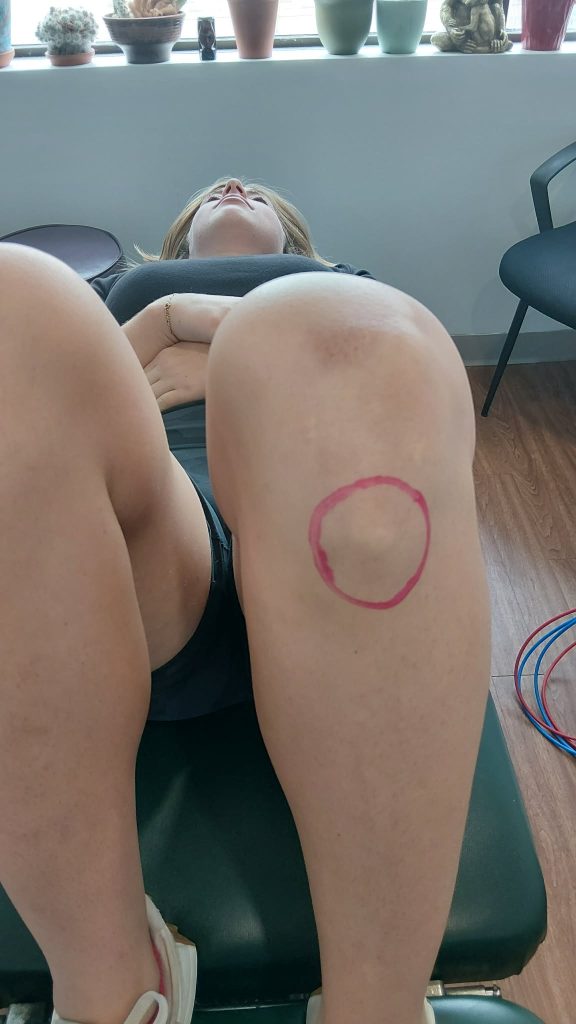
 Does your child have a painful bump just below the kneecap that gets worse with soccer, basketball, hockey, running or jumping?
Osgood-Schlatter disease is a common cause of knee pain in active kids and teenagers, and it is something we regularly see at Nottinghill Family Wellness Centrein Oakville.
Our goal is straightforward: get the knee feeling better, reduce the stress that keeps irritating it, improve strength and mobility, and help your child get back to their sport.
Treatment can include physiotherapy in Oakville, shockwave therapy, suction IFC, soft-tissue treatment and rehabilitation exercises depending on what we find during the assessment.
Doctor Steve also treats these sports-related knee problems using the same hands-on, soft-tissue, mobility and rehabilitation approach we use throughout the clinic.
If you are not sure whether the pain is Osgood-Schlatter or another knee problem, our knee pain treatment page covers many of the other conditions we assess.
Call 905-827-4197 to book an Osgood-Schlatter assessment or contact our Oakville clinic.
What Does Osgood-Schlatter Feel Like?
Most parents bring their child in because of pain or tenderness over the bony bump directly below the kneecap.
Common symptoms include pain below the kneecap, a tender bump at the top of the shin, knee pain with running or jumping, pain during soccer or basketball, pain when kneeling, discomfort on stairs and soreness after practices or games.
The painful area is usually the tibial tubercle, where the patellar tendon attaches to the shin bone.
If your child keeps pointing to that exact spot, particularly during a growth spurt or a busy sports season, Osgood-Schlatter is one condition we consider.
Parents looking into other sports-related complaints in children can also visit our children’s chiropractic and musculoskeletal care page.
How We Treat Osgood-Schlatter at Our Oakville Clinic
Treatment focuses on relieving the painful knee while reducing the repeated pulling and loading that keeps aggravating the tibial tubercle.
We do not automatically tell every young athlete to stop all sports for months and wait for the problem to disappear.
Instead, we assess the knee, determine what is driving the irritation and build a practical treatment and rehabilitation plan around the athlete.
1. Suction IFC for Knee Pain Relief

For a painful or irritated knee, treatment can begin with suction interferential current therapy, or IFC, when appropriate.
The suction cups and electrical stimulation are used to help with pain relief and relax the surrounding muscles before we move into hands-on treatment and rehabilitation.
For an athlete who is already sore after practices or games, getting some early pain relief can also make the rest of the treatment easier to tolerate.
2. Shockwave Therapy for Osgood-Schlatter
One of the treatment options available at our clinic is shockwave therapy.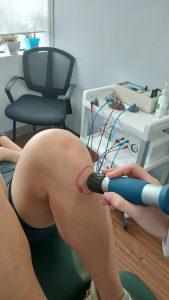
Shockwave is particularly interesting for Osgood-Schlatter because published research has specifically examined its use in young athletes with persistent Osgood-Schlatter symptoms.
We assess the athlete first and determine whether shockwave is appropriate for that particular knee. Because these are growing athletes, the exact treatment area and skeletal maturity matter.
When clinically appropriate, shockwave therapy at our Oakville clinic is included within the regular treatment visit.
There is no separate shockwave fee.
3. Soft-Tissue Treatment and Instrument Assisted Soft Tissue Therapy
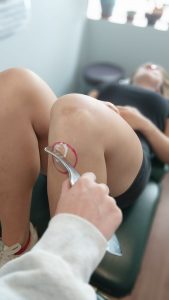
Tightness through the quadriceps can increase pulling through the patellar tendon and the painful tibial tubercle.
Hands-on treatment can focus on the quadriceps and surrounding muscles to improve mobility and reduce excessive tension around the knee.
Depending on the athlete, we can also work on the hamstrings, calves, hips and other areas affecting lower-extremity movement.
4. Physiotherapy for Osgood-Schlatter
Physiotherapy is an important part of Osgood-Schlatter treatment because reducing pain is only one part of getting a young athlete back to sport.
Our Oakville physiotherapy team can assess strength, flexibility, movement and sports demands and build a rehabilitation program around the athlete’s age, sport and current symptoms.
People in the United States often search for Osgood-Schlatter physical therapy. Physical therapy and physiotherapy describe the same profession in this context, with “physiotherapy” being the usual term in Canada.
Rehabilitation can include work for the quadriceps, hamstrings, calves, hips and gluteal muscles along with single-leg strength, balance and eventually progressive running and jumping exercises.
We keep rehabilitation practical. A young athlete who already has school, homework and four soccer practices does not need an hour of complicated exercises every night.
They need the right exercises, the right amount and a plan they can actually follow.
5. Activity and Return-to-Sport Planning
A huge part of Osgood-Schlatter treatment is understanding how much load the knee is actually receiving.
A child may officially play soccer three times a week but also have school gym, lunchtime soccer, skills training, backyard practice and a weekend tournament.
We identify which activities are producing the biggest flare-ups and decide what needs to be temporarily reduced or modified.
Then we progressively increase activity as pain, strength and tolerance improve.
Our sports injury treatment in Oakville page explains more about how Doctor Steve and our clinic manage injuries in active adults, teenagers and young athletes.
Can My Child Keep Playing Sports?
Often, yes.
An Osgood-Schlatter diagnosis does not automatically mean a child needs to stop every sport.
What matters is how much pain the athlete is experiencing, whether symptoms are getting progressively worse and how the knee responds to the current training load.
A soccer player may be able to continue practices with certain drills reduced. A basketball player may need to temporarily decrease jumping volume. Another athlete may need a short reduction in overall training before gradually building back up.
For young athletes who need progressive strengthening and a safe return to activity, learn more about our sports physiotherapy in Oakville program.
Our goal is to keep the athlete participating as much as reasonably possible while allowing the irritated knee to settle.
Does Footwear or Foot Mechanics Matter?
Sometimes.
The foot and ankle are part of the entire lower-extremity chain, so we can assess them when the athlete’s movement suggests they are relevant.
That does not mean every child with Osgood-Schlatter needs custom orthotics.
If foot mechanics appear to be contributing to the way the athlete runs, walks or loads the knee, we can discuss footwear or a custom orthotics assessment in Oakville when appropriate.
Why Families Choose Our Oakville Clinic
At Nottinghill Family Wellness Centre and Glen Abbey Physiotherapy, families have access to physiotherapy, sports-injury assessment, shockwave therapy, suction IFC, hands-on treatment, rehabilitation and acupuncture in one clinic.
That allows us to adjust the treatment plan based on what the athlete actually needs instead of forcing every child into exactly the same approach.
Doctor Steve regularly treats sports-related knee problems and is also available for Saturday appointments from 7:00 a.m. to 11:30 a.m., which can make treatment easier around school, games and tournament schedules.
Our clinic is located at 1131 Nottinghill Gate in Glen Abbey, Oakville, and we regularly see families from Oakville, Burlington, Milton and surrounding communities.
Call 905-827-4197 to book an assessment or contact our Oakville chiropractic and physiotherapy clinic.
What Is Osgood-Schlatter Disease?
Osgood-Schlatter disease is irritation of the developing area where the patellar tendon attaches to the tibial tubercle, the bump at the top of the shin bone just below the knee.
During periods of growth, repeated pulling through the patellar tendon can irritate this developing attachment point.
That is why Osgood-Schlatter is especially common in active children and teenagers involved in sports requiring frequent running, jumping, kicking or changing direction.
Soccer, basketball, hockey, volleyball, track and field, gymnastics and dance are common examples.
The American Academy of Orthopaedic Surgeons guide to Osgood-Schlatter disease provides a broader medical overview.
For other causes of pain around the knee, visit our Oakville knee pain treatment guide.
Why Is There a Bump Below the Knee?

The tibial tubercle is the point where the patellar tendon attaches to the shin.
Repeated traction on this developing area can make it irritated and more prominent.
Some young athletes end up with a very noticeable bump below the kneecap.
The bump itself does not necessarily have to disappear for symptoms to improve. Some people continue to have a prominent tibial tubercle into adulthood even though the painful stage of Osgood-Schlatter has resolved.
What Causes Osgood-Schlatter to Flare Up?
Running, jumping, kicking and repeated squatting increase the forces travelling through the quadriceps, patellar tendon and tibial tubercle.
A sudden increase in activity is often important.
That can include starting a new sports season, adding another team, playing several games during a tournament, increasing running volume or going through a rapid growth period.
This is why we want to know the athlete’s entire weekly schedule, not just how many official team practices they attend.
Osgood-Schlatter vs Patellar Tendonitis
Both conditions can cause pain at the front of the knee.
Osgood-Schlatter usually produces tenderness over the tibial tubercle below the kneecap in a growing athlete.
Patellar tendinopathy tends to involve the tendon itself and is often painful closer to the lower edge of the kneecap.
Age, exact tenderness location, activity history and examination findings help us differentiate between them.
If you are unsure what structure is actually causing the symptoms, start with a knee pain assessment at our Oakville clinic.
Does Osgood-Schlatter Need an X-Ray?
Most Osgood-Schlatter cases can be identified through the history and physical examination, so an X-ray is not automatically required.
Imaging becomes more important when there has been significant trauma, the symptoms are unusual, the pain is becoming progressively worse or the examination suggests another diagnosis.
If further medical investigation is appropriate, we recommend that rather than repeatedly treating a problem that is not responding as expected.
How Long Does Osgood-Schlatter Last?
Recovery varies significantly between athletes.
Some improve relatively quickly once the workload is changed and rehabilitation begins, while others can experience recurrent symptoms over a much longer period.
Research following adolescents with Osgood-Schlatter has shown that symptoms can persist longer than many families expect.
That is why we focus on actively managing pain, strength, mobility and sports load rather than simply telling every child to wait until they “grow out of it.”
You can review the 24-month Osgood-Schlatter prognosis research for more information about persistent symptoms.
Can Adults Have Osgood-Schlatter Pain?
Osgood-Schlatter develops during skeletal growth, but some adults continue to have pain or tenderness around an old prominent tibial tubercle.
Adult searches commonly include tibial tubercle pain in adults, tibial tuberosity pain, painful Osgood-Schlatter bump and pain when kneeling.
Persistent adult knee pain should still be assessed because an old history of Osgood-Schlatter does not automatically mean it is the only cause of pain years later.
Acupuncture for Osgood-Schlatter Knee Pain
For young patients who are comfortable with acupuncture, it can be considered as an additional pain-management option.
Dr. Jenn provides acupuncture in Oakville and can assess whether it has a useful role alongside treatment and rehabilitation.
There is limited research specifically involving acupuncture and Osgood-Schlatter, so it should be viewed as an adjunct rather than the main treatment approach.
Families can also read our acupuncture for knee pain in Oakville guide.
What Does the Research Say About Osgood-Schlatter Treatment?
Research supports an active rehabilitation approach involving activity modification, strengthening and progressive return to activity.
A prospective adolescent study found improvement following an activity-modification and strengthening program, although return to unrestricted sport took longer than improvement in symptoms. Read the Osgood-Schlatter strengthening and activity-modification study.
Shockwave has also been specifically studied in persistent Osgood-Schlatter cases. Small studies have reported encouraging outcomes, although the available evidence is not strong enough to promise a particular result for every athlete.
You can review the radial shockwave therapy research for persistent Osgood-Schlatter disease and the focused shockwave therapy research in young athletes with Osgood-Schlatter.
That research is why we are comfortable discussing shockwave as one potential component of care while keeping the overall plan focused on the individual athlete, activity management, physiotherapy, strength and rehabilitation.
Frequently Asked Questions About Osgood-Schlatter
What is the best treatment for Osgood-Schlatter disease?
Treatment usually focuses on reducing the activity that repeatedly aggravates the tibial tubercle while maintaining as much normal activity as possible. Physiotherapy, strengthening, flexibility work and progressive return to sport are commonly used. At our Oakville clinic, treatment can also include suction IFC, hands-on therapy and shockwave therapy when appropriate.
How do you treat Osgood-Schlatter?
We first determine how irritated the knee is and which activities are driving the symptoms. Treatment can then include pain-relief therapy, soft-tissue treatment, physiotherapy, strengthening, activity modification and gradual return to sport. Selected persistent cases can also be assessed for shockwave therapy.
How long does Osgood-Schlatter last?
There is no single timeline. Some young athletes improve within weeks or months, while others experience recurrent symptoms for considerably longer, particularly during periods of rapid growth and heavy sports participation.
What causes Osgood-Schlatter to flare up?
Flare-ups commonly follow increases in running, jumping, kicking or training volume. Tournament weekends, additional sports teams, school athletics and rapid growth can all increase stress through the tibial tubercle.
How can you relieve Osgood-Schlatter pain?
Reducing the activities producing the biggest flare-ups can help. Ice can provide short-term comfort, while physiotherapy, appropriate strengthening, flexibility work and pain-relief treatment can be used depending on the athlete. Persistent pain should be assessed rather than repeatedly pushed through.
What exercises are good for Osgood-Schlatter disease?
Exercises often focus on the quadriceps, hamstrings, calves, hips and gluteal muscles. The appropriate program depends on the athlete’s strength, flexibility, pain level and sport. The goal is not simply stretching the painful knee but improving its ability to tolerate progressively greater loads.
What exercises should be avoided with Osgood-Schlatter?
There is no universal list of banned exercises. Activities that repeatedly cause a significant increase in pain may need to be temporarily reduced or modified. This can include high-volume jumping, sprinting, deep loaded squats or repetitive kicking in some athletes.
Can my child play soccer with Osgood-Schlatter?
Often they can continue participating at some level. The answer depends on the severity of symptoms and how the knee responds to training. Practice duration, running volume, drills, games or tournaments may need temporary modification while treatment and physiotherapy progress.
Can you run with Osgood-Schlatter disease?
Some athletes can continue running if symptoms remain controlled, while others need a temporary reduction in running volume or intensity. Increasing pain during or after running is a sign that the current workload may be too high.
Does a knee strap or brace help Osgood-Schlatter?
A patellar tendon strap can be useful for some athletes by changing how forces are distributed around the painful area. It is not necessary for every child and should complement rather than replace rehabilitation and activity management.
Does the Osgood-Schlatter bump go away?
The pain can settle even if the bump remains. Some people continue to have a prominent tibial tubercle into adulthood without ongoing symptoms. Treatment should focus more on pain and function than on trying to make the bump disappear.
Can Osgood-Schlatter happen in only one knee?
Yes. Osgood-Schlatter can affect one knee or both knees. Having symptoms on only one side does not rule it out.
Can adults have Osgood-Schlatter disease?
The condition develops during growth, but adults can continue to experience symptoms around a prominent tibial tubercle left from adolescence. Adult pain in this area should be assessed because other conditions can produce similar symptoms.
Can orthotics help Osgood-Schlatter?
Orthotics are not automatically required for Osgood-Schlatter. If an assessment identifies foot mechanics that are influencing the way the athlete walks or runs, footwear changes or custom orthotics can be discussed as part of the broader treatment plan.
Does Osgood-Schlatter ever need surgery?
Surgery is uncommon in growing athletes with typical Osgood-Schlatter disease. Persistent symptoms after skeletal maturity may occasionally require an orthopaedic opinion, particularly when an ossicle or prominent tibial tubercle remains significantly symptomatic.
Book Osgood-Schlatter Treatment in Oakville
If your child keeps complaining about pain below the kneecap, has developed a painful bump at the top of the shin or is struggling to get through practices and games, bring them in and let us assess it.
Our goal is to get the pain under control, identify what is repeatedly irritating the knee and build a treatment and rehabilitation plan that gets the athlete back toward normal activity.
Treatment at our Oakville clinic can include physiotherapy, suction IFC, soft-tissue treatment, rehabilitation and shockwave therapy when appropriate.
Doctor Steve also treats sports-related knee injuries using hands-on treatment, mobility work and rehabilitation alongside the rest of our treatment team.
Call 905-827-4197 to book an Osgood-Schlatter assessment or contact our Oakville clinic.
Nottinghill Family Wellness Centre / Glen Abbey Physiotherapy
1131 Nottinghill Gate, Oakville, Ontario
Doctor Steve is available Saturdays from 7:00 a.m. to 11:30 a.m.